Construction Project Costing and the Financial Year End in Malaysia
A
Ashraf Ibn Zelt
4 September 2026
22 min read
#construction#bookkeeping#project-costing#financial-year#lhdn#compliance

Picture made with AI
Ashraf Ibn Zelt
4 September 2026
Turning coded costs into a profit per contract — separate accounts, percentage of completion, the ruling's own formula, and retention at year end.
Last reviewed: 4 September 2026
Part one covered what each document is. Part two covered where to put it, and asked you to write a project code on every bill before it left your desk. This part answers the question that habit exists to serve: at the financial year end, what did each project earn, what did it cost, and how much belongs in this year of assessment rather than the next.
The instinct is to wait. The project is unfinished, the final account is not agreed, the retention is not released — so the profit does not feel real yet. That instinct is wrong for tax in Malaysia, in a specific, written way. KU 5/2025 s.6.13 says so directly, and this article spends more time on that paragraph than on any other.
The rest is mechanical. If every bill carries a project code, the cost per contract is a sorting job rather than an investigation.
General information, not tax or legal advice. Consult a qualified Malaysian tax advisor.
Section 13 of KU 5/2025 lists the information required when preparing accounts and statements for a construction contractor, for review or audit. Part one covered the document list at s.13(a). The four requirements after it are about numbers, and every one is per contract.
| What is required | Section | Where it comes from in your system |
|---|---|---|
| The type of contract stated — the ruling's examples are fixed price or cost-plus, harga tetap atau kos tokok — and the value of each contract determined clearly | s.13(b) | The letter of award and signed contract in /01-Contract, plus every variation order that has moved the value since |
| The expected completion period for each contract, determined carefully | s.13(c) | The contract programme, adjusted for any extension of time granted |
| The estimated cost of each contract, determined carefully | s.13(d) | The tender pricing build-up that came into the project folder on award, updated for what has actually happened |
| Progress claims received or receivable for each contract, distinguished and determined clearly | s.13(e) | /03-Progress-Claims-Out, one folder per project |
Read the first, third and fourth rows together and the year-end job appears in outline. You need a contract value and an estimated total cost for each contract, and the year's claims separated by contract. Those are the inputs to the formula later in this article. And s.13(d) asks for the estimate to be determined carefully, which is why part two told you to keep the tender pricing in the project folder: a year later, that build-up is the only honest starting point.
Everything above rests on one paragraph, worth reading in the original.
11.3.4 Jika terdapat dua atau lebih kontrak dijalankan secara serentak, perbelanjaan pembinaan tersebut hendaklah ditunjukkan secara berasingan. Akaun perbelanjaan pembinaan bagi setiap kontrak hendaklah disimpan secara berasingan dan mesti disediakan untuk setiap TT.
Translation: where two or more contracts are carried out at the same time, that construction expenditure must be shown separately. The construction expenditure account for each contract must be kept separately and must be prepared for every year of assessment. KU 5/2025 s.11.3.4. TT is tahun taksiran — the year of assessment.
Three things are easy to skim past. Kept separately — not merged and split apart on a spreadsheet in December. For each contract — not one account for the construction business. Prepared for every year of assessment — including the middle years where nothing closes.
Separate accounts per contract get treated as something you do if you are organised, or if you expect to be audited. They are neither. They are what the ruling says the books must contain wherever two or more contracts run at once, which for most contractors is always.
The reason sits earlier in the same document. Section 5 is headed Punca Pendapatan Berasingan Kontrak Pembinaan — separate source of income for construction contracts — and treats each contract as a separate and distinct source of income. Two sources of income can no more share one profit-and-loss account than two businesses could.
Section 11.3.5 is the enforcement half. A contractor must make appropriate adjustments to the expenditure shown in the construction expenditure account, and where the cost of another contract has been included, that cost must be removed in order to arrive at the allowable construction expenditure carried forward to the following year of assessment. A misposted cost does not net off across projects; it comes out of the account it does not belong to.
The audit advantage falls out of this rather than driving it. A contractor whose accounts already separate the contracts answers s.13 from their own books; one who does not reconstructs the same figures under deadline, from memory, in front of an officer looking at the same gap.
Take one contract whole. This is what a construction expenditure account and its matching income figures amount to in practice.
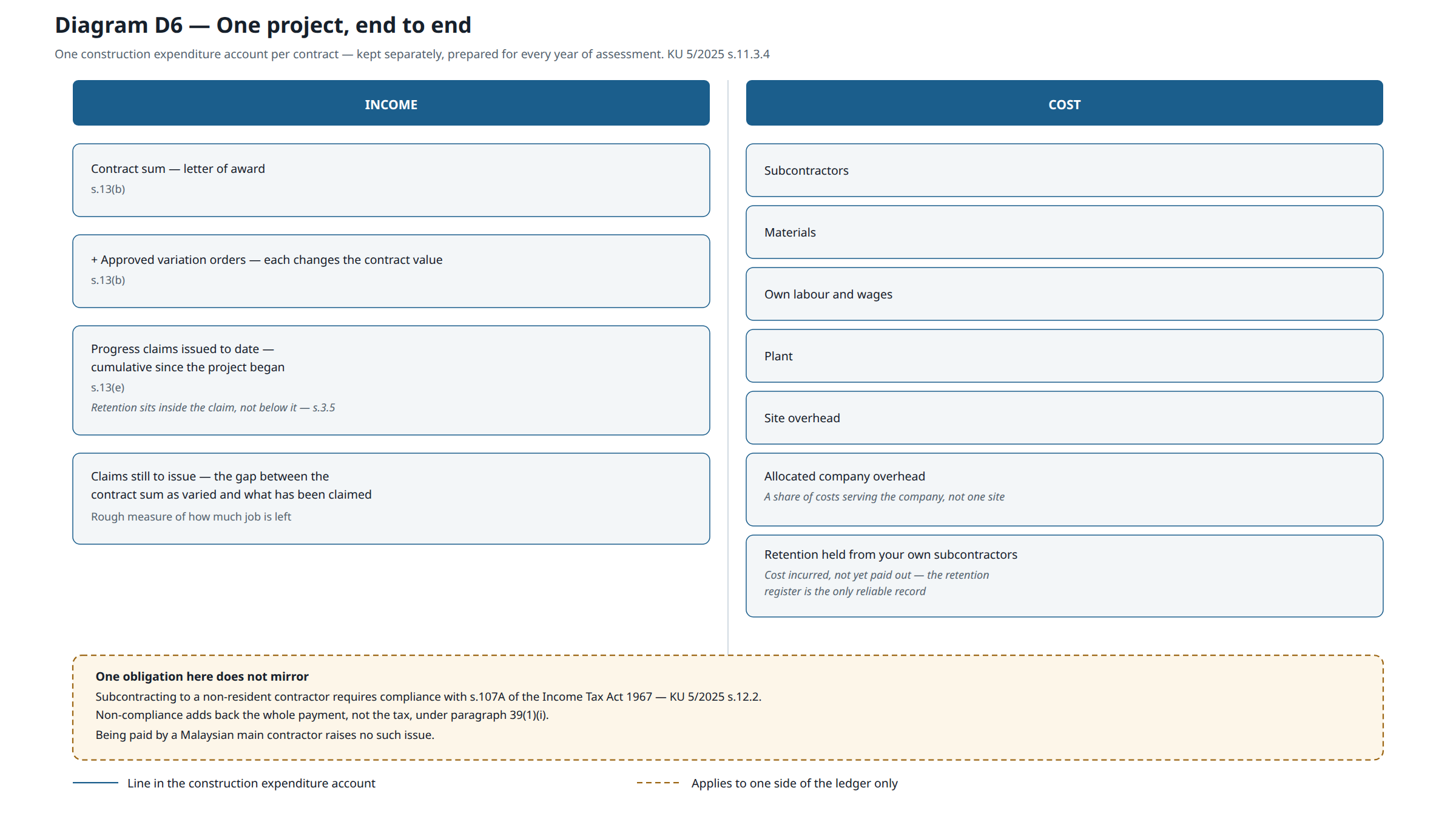
Start with the contract sum from the letter of award, then approved variation orders, because each changes the contract value that s.13(b) requires to be determined clearly. A variation instructed verbally on site and never documented is a hole in this figure.
Below that, progress claims issued to date, cumulative since the project began — and within that total, the portion retained by the party above you. Retention sits inside the claim, not below it: KU 5/2025 s.3.5 defines a progress claim as any amount claimed for work carried out under the contract, including the retention amount, whether paid or not.
Last, the claims still to issue — the gap between the contract sum as varied and what has been claimed, a rough measure of how much job is left.
The cost side is where the project code either paid off or did not. Subcontractors, materials, own labour and wages, plant, site overhead — each a total you should be able to read out of your own coding.
Two rows are the ones people get wrong. Allocated company overhead, a share of costs serving the company rather than any one site. And retention you are holding from your own subcontractors, a cost incurred but not yet paid out, for which the retention register from part two is the only reliable record.
One obligation here does not mirror. Where you subcontract to a non-resident contractor, KU 5/2025 s.12.2 requires compliance with section 107A of the Income Tax Act 1967 and states that non-compliance causes the amount to be added back under paragraph 39(1)(i) — the whole payment, not the tax on it. Being paid by a Malaysian main contractor raises no such issue.
Some costs genuinely serve two or three jobs. Part two gave the rule: split them on a stated basis and write that basis on the bill. The year-end consequence is now visible — a cost split on a basis nobody recorded cannot be defended in either contract's account, and under s.11.3.5 a cost belonging to another contract has to come out of the account it is sitting in.
Costs serving the whole company go to overhead. Forcing them onto a project is worse than leaving them off: it makes one contract's profit wrong in a way nobody can unpick later.
At the financial year end every project falls into one of two states, and they are treated differently.
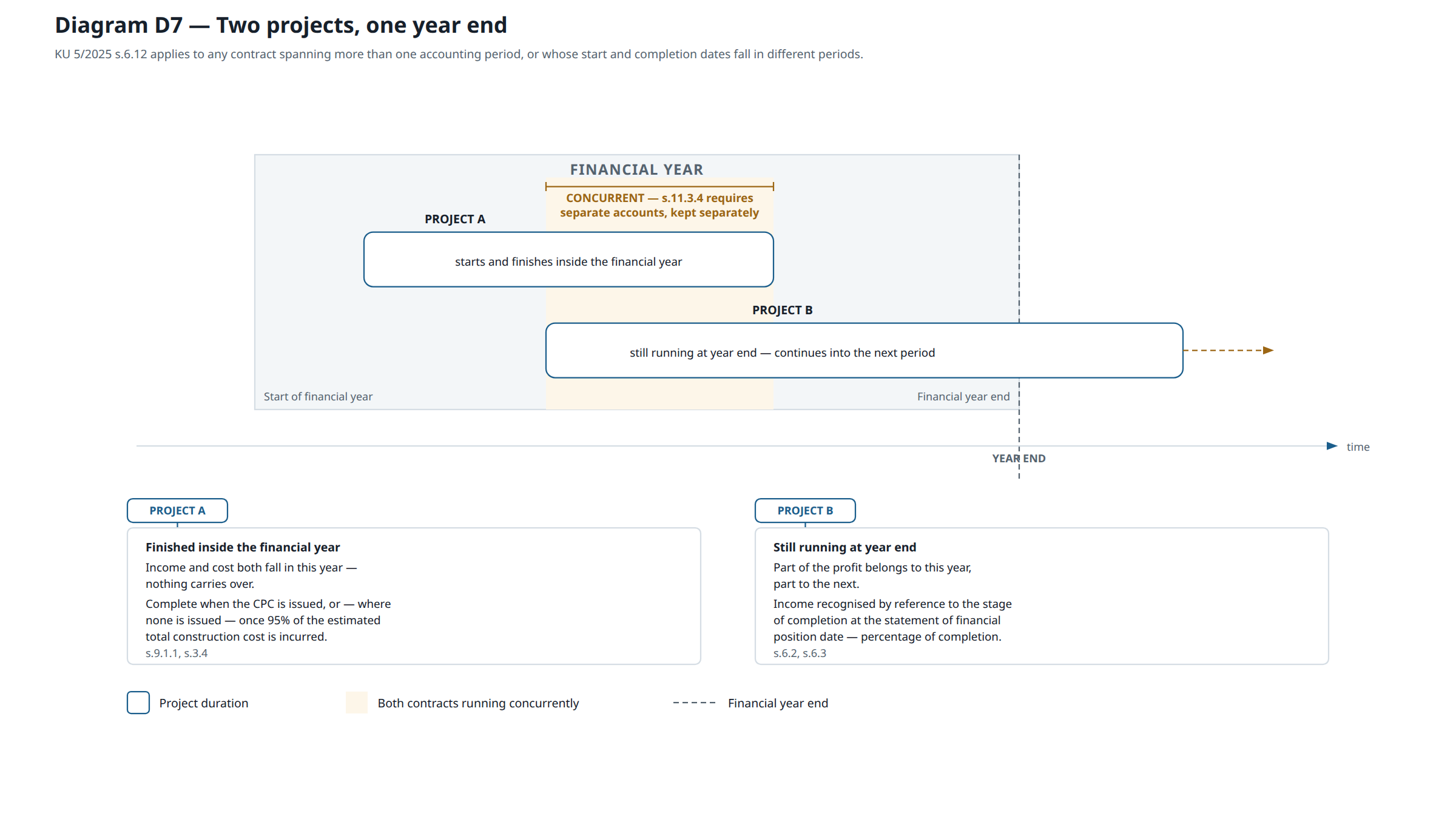
Section 6.12 sets out when the ruling applies at all: to construction contracts taking more than one accounting period to complete, or where the date the contract activity was signed and the date it was completed fall in different accounting periods. Those two limbs catch almost every contract of any size.
A project that started and finished inside the same financial year is the simple case: income and cost both fall in that year and nothing carries over.
Finished has a defined meaning here. Under s.9.1.1 a contract is complete on the date the Certificate of Practical Completion is issued, or any other certificate having the same effect; where none is issued, on the date the contract is substantially completed — which s.3.4 defines as ninety-five per cent of the estimated total construction cost having been incurred. A job that feels finished because the site has gone quiet is not finished unless one of those tests is met.
The second case needs work. The contract started inside the year and is still running at the year end, so part of it belongs to this year of assessment and part to the next.
Section 6.2 requires the income from a construction contract business to be recognised while the contract activity is being carried out, by reference to the stage of completion at the date of the statement of financial position. Section 6.3 completes it: under the percentage of completion method, revenue is matched with the construction expenditure incurred for the basis period, up to the stage the contract has reached. In plain terms, a profit has to be brought into this year for a project nowhere near finished, in proportion to how far it has got.
This is the most important paragraph in the ruling for a contractor keeping their own books, and it is short.
6.13 Di mana suatu kontraktor pembinaan menyediakan akaun dengan menggunakan kaedah kontrak siap, kontraktor pembinaan tersebut dikehendaki mengira tanggungan cukai bagi suatu TT dengan menggunakan kaedah peratusan siap untuk menentukan dan mengiktiraf anggaran untung kasar setiap tahun. Kontraktor pembinaan tidak dibenarkan menangguhkan pengiktirafan keuntungan sehingga kontrak pembinaan siap.
Translation: where a construction contractor prepares accounts using the completed contract method, that contractor is required to compute the tax liability for a year of assessment using the percentage of completion method to determine and recognise the estimated gross profit each year. The construction contractor is not permitted to defer the recognition of profit until the construction contract is complete. KU 5/2025 s.6.13.
Two separate points, both binding.
The first: the method your accounts use does not settle the question. A contractor whose financial statements are prepared on a completed contract basis is still required to compute the tax liability on percentage of completion. The accounts and the tax computation part company, and the computation is where the ruling bites.
The second: the flat prohibition in the last sentence. No threshold makes deferral acceptable, and there is no exception for a contract whose outcome is genuinely unclear. Every year of the contract carries its share.
The practical consequence is a tax charge on a project that has not paid you yet, in a year where the cash position looks nothing like the profit — uncomfortable to plan for, expensive to discover in an audit, and the reason this belongs in a year-end routine rather than a conversation with your accountant the following August.
Section 6.4 gives the computation. The estimated gross profit — anggaran untung kasar — of a construction contractor for the basis period for a year of assessment, in respect of a construction contract, is an amount determined by the following formula:
A ÷ B × C
| Term | What it is | The ruling's wording |
|---|---|---|
| A | Total progress claims received and receivable in that basis period | The figure must show the actual position existing at the date of the statement of financial position |
| B | The contract sum | jumlah harga atau amaun kontrak |
| C | The estimated total gross profit from the contract | jumlah anggaran untung kasar dari kontrak |
The qualification on A does real work. A is not what the bank received. It is claims received and receivable in the basis period, at the actual position at the statement of financial position date, with retention inside it for the reason part one gave.
KU 5/2025 works the formula through itself. The figures below are the ruling's, at Contoh 5 — not an illustration invented for this article.
| Term | The ruling's figure |
|---|---|
| A — progress claims received and receivable in the basis period | RM1,500,000 |
| B — the contract sum | RM8,000,000 |
| C — estimated total gross profit | RM1,200,000 |
| Estimated gross profit for the basis period, A ÷ B × C | RM225,000 |
Walk it through, because the shape is what matters. A ÷ B first: RM1,500,000 of claims against a contract sum of RM8,000,000, which is 18.75 per cent — the stage the contract has reached, measured by what has been claimed rather than by anyone's impression of the site. Then × C: 18.75 per cent of the RM1,200,000 the contract is expected to make in total, giving RM225,000, the figure the ruling itself prints.
The number turns on three things you already hold per contract: the year's claims from /03-Progress-Claims-Out, the contract sum as varied, and an estimate of total gross profit built from the tender pricing and what the job has cost so far. Two are documents. Only C is an estimate, which is why s.13(d) asks for the estimated cost to be determined carefully — if C is wrong, every year of the contract is wrong until somebody corrects it.
Large contracts are often divided into phases, and the ruling deals with that directly. Section 6.14 states that the amount of income recognised is determined by reference to the stage of completion at the end of each accounting period, and that this applies also to a large contract divided into phases taking more than one accounting period or year to complete. Then the operative sentence:
Di mana kontrak dibahagikan kepada beberapa fasa, asas peratusan siap hendaklah digunakan untuk setiap fasa secara berasingan.
Translation: where a contract is divided into several phases, the percentage of completion basis must be used for each phase separately. KU 5/2025 s.6.14.
Separately means the arithmetic above is done phase by phase, each with its own A, B and C, rather than once across the whole contract. In filing terms this is the project code instinct again: the phase has to be visible in the coding, or the computation cannot be built without going back through the claims one at a time.
The rule from part one does not change: KU 5/2025 s.11.5.4 provides that for income tax purposes the progress claim amount, including any money retained under the contract that is receivable, is included in the contractor's gross income at the date the progress claim is issued to obtain payment. Not the date of certification, not of payment, and not the date the retention is released.
What is new at year end is the balance that leaves behind. Section 11.5.3 records that the conditions of a construction contract require the customer to retain a percentage of the payment on each progress claim until all the work has been satisfactorily completed; that this money is usually held for six months after the contract is completed; and that the amount held is not paid until the conditions specified in the contract for its payment are met.
So a retention balance at year end has three properties. It is income you have already recognised. It is cash you do not have. And its release is governed by the contract, not the calendar — six months after completion is what the ruling describes as the usual position; the actual trigger is written into your contract.
The failure this sets up arrives a year later. Released retention turns up as a payment with no invoice attached, and the temptation is to book it as income when it lands. It was income when the claim was issued. Booking it again overstates the later year, and the only defence is part two's retention register, showing which claim each balance came from.
Now the mirror, and it is the half most often missed.
Where you are the subcontractor, the main contractor above holds retention from you. Where you are the main contractor, you hold it from your own subcontractors. Both are live at the same year end, on different contracts, with different release dates.
| At year end | What it is | What it depends on |
|---|---|---|
| Retention receivable | Money already in your gross income under s.11.5.4, not yet paid to you | The release conditions in the contract above you |
| Retention payable | A cost of that contract, incurred but not yet paid out | The release conditions in your subcontract, and whether the defects are made good |
They do not net off and they do not share a release date. A receivable balance on M-TRX02 and a payable balance on the same project are two obligations with two triggers, each belonging in that contract's account. Section 11.3.4 already told you the accounts are kept per contract, which is what stops the two collapsing into one company-level figure that means nothing.
The register is one line per balance: project code, the claim it came from, the amount, whether it is held from you or by you, and the event that releases it.
This is what you should be able to produce for each contract at year end, without an investigation.
| What you must be able to produce | Source |
|---|---|
| Contract sum, from the letter of award | s.13(b) — the value of each contract determined clearly |
| Variation orders approved in the year, and the revised contract value | s.13(b) |
| Contract type — fixed price or cost-plus | s.13(b) |
| Progress claims issued in the basis period, and cumulatively | s.13(e) — distinguished per contract; this is A in the formula |
| Estimated total cost of the contract | s.13(d) — determined carefully |
| Estimated total gross profit | s.6.4 — this is C in the formula |
| Costs to date by category — subcontractors, materials, labour, plant, site overhead | s.11.3.4 — the construction expenditure account for each contract |
| Allocation basis for any cost shared between contracts | s.11.3.5 — costs of another contract must be removed |
| Retention receivable, with the claim it came from and its release condition | s.11.5.4 and s.11.5.3 |
| Retention payable to your own subcontractors, with release conditions | The cost side of the same contract account |
| Expected completion date, and any extension of time granted | s.13(c) — determined carefully |
| Phase breakdown, where the contract is phased | s.6.14 — percentage of completion applied to each phase separately |
Notice how much of that already sits in the project folder. Only two rows are genuinely new work: the estimated total cost, and the estimated total gross profit that follows from it. Everything else is a total.
That is the payoff for the coding habit. A contractor who coded every bill spends the year end adding up. One who did not spends it deciding which pile each bill belonged to, twelve months after the only person who knew left the site.
Parts one, two and three were written for the person doing the work: what the documents are, where they go, and what they add up to. Part four steps back and is written for the director — what the whole system is for, and where the money and the risk sit.
No. KU 5/2025 s.6.13 states that a construction contractor is not permitted to defer the recognition of profit until the construction contract is complete, and that where the accounts are prepared on the completed contract method the contractor must still compute the tax liability using percentage of completion. There is no threshold or exception in the paragraph.
By the formula at KU 5/2025 s.6.4: A ÷ B × C, where A is the total progress claims received and receivable in the basis period, B is the contract sum, and C is the estimated total gross profit. The ruling works it through at Contoh 5 with its own figures: RM1,500,000 ÷ RM8,000,000 × RM1,200,000 = RM225,000 of estimated gross profit for that basis period.
Progress claims received and receivable in the basis period, with the figure showing the actual position existing at the date of the statement of financial position — not cash received. Retention is inside it, because s.3.5 defines a progress claim as any amount claimed for work carried out under the contract, including the retention amount, whether paid or not.
Yes, wherever two or more contracts run at the same time. KU 5/2025 s.11.3.4 requires the construction expenditure to be shown separately, and an account for each contract to be kept separately and prepared for every year of assessment. The reason is in s.5 — each contract is a separate and distinct source of income.
It has to be taken out. KU 5/2025 s.11.3.5 requires appropriate adjustments to the construction expenditure account, and where the cost of another contract has been included, that cost must be removed in arriving at the allowable construction expenditure carried forward. Netting it off against another project is not an adjustment.
Phase by phase. KU 5/2025 s.6.14 states that where a contract is divided into several phases, the percentage of completion basis must be used for each phase separately. Each phase needs its own claims, its own contract value and its own estimated gross profit.
Project costing sounds like a management exercise and is actually a compliance one. KU 5/2025 s.11.3.4 requires a construction expenditure account for each contract, kept separately and prepared for every year of assessment, because s.5 treats each contract as its own source of income. Section 11.3.5 requires a misposted cost to come back out. Section 13(b) to (e) asks for contract type and value, expected completion, estimated cost and progress claims, per contract.
The one thing to carry away above all is s.6.13. Profit may not be deferred until the contract finishes, and preparing the accounts on a completed contract basis does not change the tax computation. Work out A ÷ B × C for every unfinished contract at every year end, revisit the estimated gross profit against what the job has cost, and keep the retention balances recorded per contract with their release conditions. Do that and the year end is arithmetic. Skip it and it is archaeology.
Ashraf Ibn Zelt writes on Malaysian tax compliance and bookkeeping for Zelt Digital, an accounting and tax services platform serving SMEs and professional firms with LHDN compliance, e-Invoice implementation, payroll and CFO advisory across Malaysia. Visit zelt.digital to learn more.
Related reading: Fractional CFO Malaysia: What It Is & When to Hire