Construction Contractor Documents Explained: Malaysia
A
Ashraf Ibn Zelt
4 September 2026
18 min read
#construction#bookkeeping#progress-claims#e-invoice#subcontractors#compliance
Picture made with AI
Ashraf Ibn Zelt
4 September 2026
Every document a Malaysian construction contractor handles — progress claims, retention, e-Invoices, subcontractor packs — and what each one proves.
Last reviewed: 4 September 2026
Your job is to make sure that for every ringgit the company earns or spends, there is a document proving what it was for, which project it belonged to, and when it happened. That is the whole role. Construction makes it harder for one reason: the money does not arrive when the work is done. Work happens in March, is claimed in April, certified in May, paid in June, and part is not paid until a year after the building is finished. Every step produces a document. Know what each proves and the job is orderly; otherwise you spend December reconstructing March from memory.
This article covers what each document is and where it comes from. Part two covers where to put everything.
General information, not tax or legal advice. Consult a qualified Malaysian tax advisor.
Nothing in your filing makes sense until you can picture the money.
Work gets done on site. Someone measures how much, usually at month end, and prepares a progress claim — a request for payment for work completed so far, sent up to whoever pays for that project. Their quantity surveyor assesses it and issues a certificate stating how much they agree with — LHDN calls this a progress billing certificate; on site everyone says interim certificate. That figure is the certified amount, and it is often less than you claimed.
Only then does the company raise an invoice and submit it to LHDN's MyInvois system as an e-Invoice. The payer pays, but not the full certified amount: they hold back a percentage, called retention, as security that you will return and fix defects. Part is released at practical completion, the balance after the defects liability period ends.
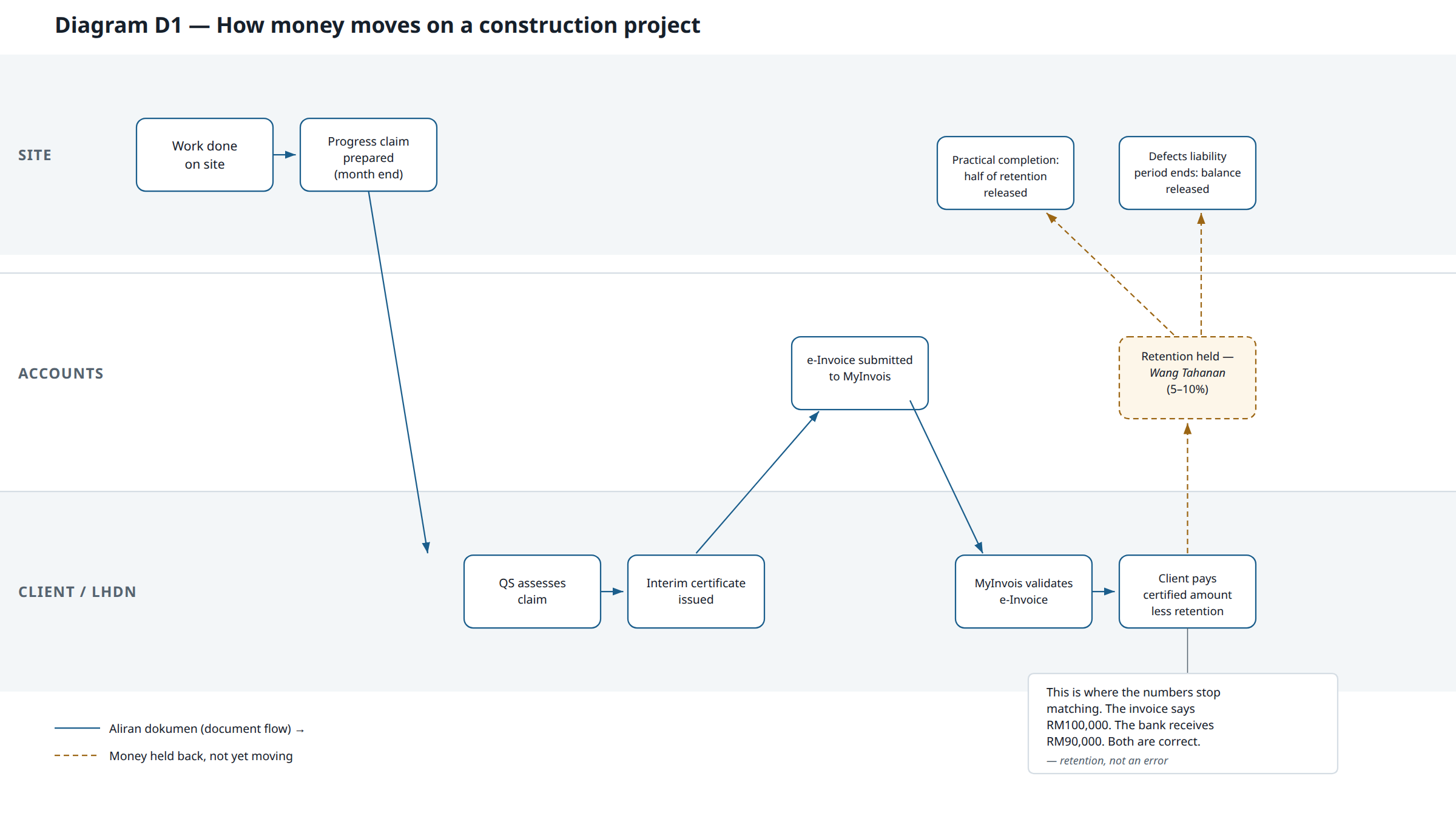
Hence the confusion at the centre of this job: the invoice says RM100,000, the bank receives RM90,000, and both are correct.
The company is a main contractor on some projects and a subcontractor on others. That is normal, and it changes what lands on your desk.
As main contractor, it holds the contract with the party who owns the project, claims upward to them, and hires subcontractors below — piling, electrical, tiling — receiving their claims and paying them. As subcontractor, it sits below another main contractor and claims upward to them, not to the owner.
Almost everything mirrors. Progress claims, variation orders, e-Invoices, back charges and damages for delay all exist in both directions — issued upward to whoever pays you, received from whoever you pay. So does retention: on one project the payer above holds it from you, on another you hold it from your subcontractor.
One thing does not mirror. Withholding is triggered by paying a non-resident, not by being paid. KU 5/2025 s.12.2 requires a contractor who subcontracts to a non-resident contractor to comply with section 107A of the Income Tax Act 1967, and states that non-compliance causes the amount to be added back under paragraph 39(1)(i) — the whole payment, not the tax on it. If a subcontractor is not a Malaysian tax resident, that file goes to whoever handles tax before payment.
| Term | What it means | Malay term LHDN uses |
|---|---|---|
| Progress claim | A request for payment for work done so far. KU 5/2025 s.3.5 defines it as any amount claimed under the contract, including retention, paid or not. | tuntutan berperingkat |
| Progress billing certificate, usually called an interim certificate on site | The payer's consultant stating how much of your claim they accept. LHDN's ruling names it a progress billing certificate; "interim certificate" is ordinary industry usage, not the ruling's word. | Sijil / Bil Tuntutan Berperingkat |
| Certified vs claimed | What you asked for, versus what they agreed to. The gap is normal but must be explained. | — |
| Retention sum | A percentage of each certified claim held back until defects are made good. | wang tahanan / amaun penahanan |
| Variation order (VO) | An instruction to add or omit work. Each changes the contract value. | — |
| Back charge | A cost one party incurs through the other's failure, then charges back. Travels both ways. | — |
| Liquidated Ascertained Damages (LAD) | A pre-agreed sum payable for late completion, set by the contract. KU 5/2025 s.11.6. | Ganti Rugi Tertentu dan Ditetapkan |
| Defects liability period | The window after completion in which you must fix defects. Retention's balance is released at its end. | — |
| Certificate of Practical Completion (CPC) | Confirms the works are substantially complete. Under KU 5/2025 s.9.1.1 a contract is complete on the date the CPC is issued, or where none is issued, when it is substantially complete. | Sijil Penyiapan Praktikal |
| Final Account | The closing statement of everything owed once variations and back charges are settled. | akaun muktamad |
| Main contractor / subcontractor | Who holds the head contract, and who works under them. You are both. | — |
Where a dash appears, LHDN's rulings print no Malay term and this article does not invent one. On the CPC, KU 5/2025 is inconsistent: s.9.1.1(a) prints Sijil Penyiapan Praktikal, s.13(a)(iv) prints Sijil Penyelesaian Praktikal. This article uses the first, the term attached to the completion test.
Six are named directly by LHDN in KU 5/2025 s.13 as information required when auditing a construction contractor.
| Document | Who issues it | When | What it proves |
|---|---|---|---|
| Letter of Award (Surat Penganugerahan Kontrak) and signed contract | The party above you — owner, or main contractor | On award | A contract exists, with whom, for how much, on what retention and payment terms. s.13(a)(i) |
| Variation order | The party instructing the change | Whenever scope changes | Extra or omitted work was authorised, not assumed |
| Progress claim (tuntutan berperingkat) | You, upward — or a subcontractor, to you | Usually monthly | Value of work done. s.13(e) requires these to be distinguished per contract |
| Progress billing certificate — the interim certificate | The payer's consultant | After each claim is assessed | How much of the claim is agreed. s.13(a)(ii) |
| Tax invoice and validated e-Invoice | You, as supplier | Once certified | Your income, and the buyer's proof of expense |
| Subcontractor's validated e-Invoice | The subcontractor, as supplier | Once you certify their claim | Your cost. Without it the deduction is exposed |
| Your certification of work done | Your site or project team | Before paying a subcontractor | The work you are paying for was done |
| Payment voucher (baucar bayaran) | Your accounts function | At the point of payment | Internal authorisation for the payment |
| Bank statement (penyata bank) and transfer proof | Your bank | Monthly, per payment | The money moved, to whom, when |
| Delivery orders and site records | Suppliers, your site team | On delivery, daily | Materials arrived on that site, on that date |
| Certificate of Practical Completion (Sijil Penyiapan Praktikal) | The payer's consultant | At substantial completion | The date that triggers retention release. s.13(a)(iv) |
| Final Account (akaun muktamad) | Agreed between the parties | After completion | The final contract value. s.13(a)(iii) |
| Bills and receipts (resit) for purchases, expenses and payments, including contract workers' wages | Suppliers, payroll | Continuously | Your deductible costs. s.13(a)(v) |
This article gives no number for how long to keep these. That period comes from the Income Tax Act 1967 and the Companies Act 2016, not from any construction ruling — the e-Invoice Guideline (Version 4.8), 30 August 2026 says at s.2.3.7 only that taxpayers must retain sufficient records, and states no period. Part two sets them out. Until then, keep everything.
An e-Invoice is not a PDF you email. It is an invoice submitted to LHDN's MyInvois system, validated, and returned with LHDN's markings. Under the e-Invoice Guideline (Version 4.8), 30 August 2026, s.2.3.3, a validated e-Invoice carries an IRBM Unique Identifier Number, the date and time of validation, and a validation link; the portal's visual representation also carries a QR code for checking status (s.2.3.5). When a supplier sends you one, check for that Unique Identifier Number. If it is missing, the document has not been validated.
Timing is specific in construction. LHDN's FAQs for Construction Industry, updated 6 January 2026, Question 2, states that where a certification of work done is required, the e-Invoice can be issued upon obtaining the certificate; where none is required, the contractor must issue one for the progress claim to substantiate the income. So the sequence is claim, certificate, e-Invoice.
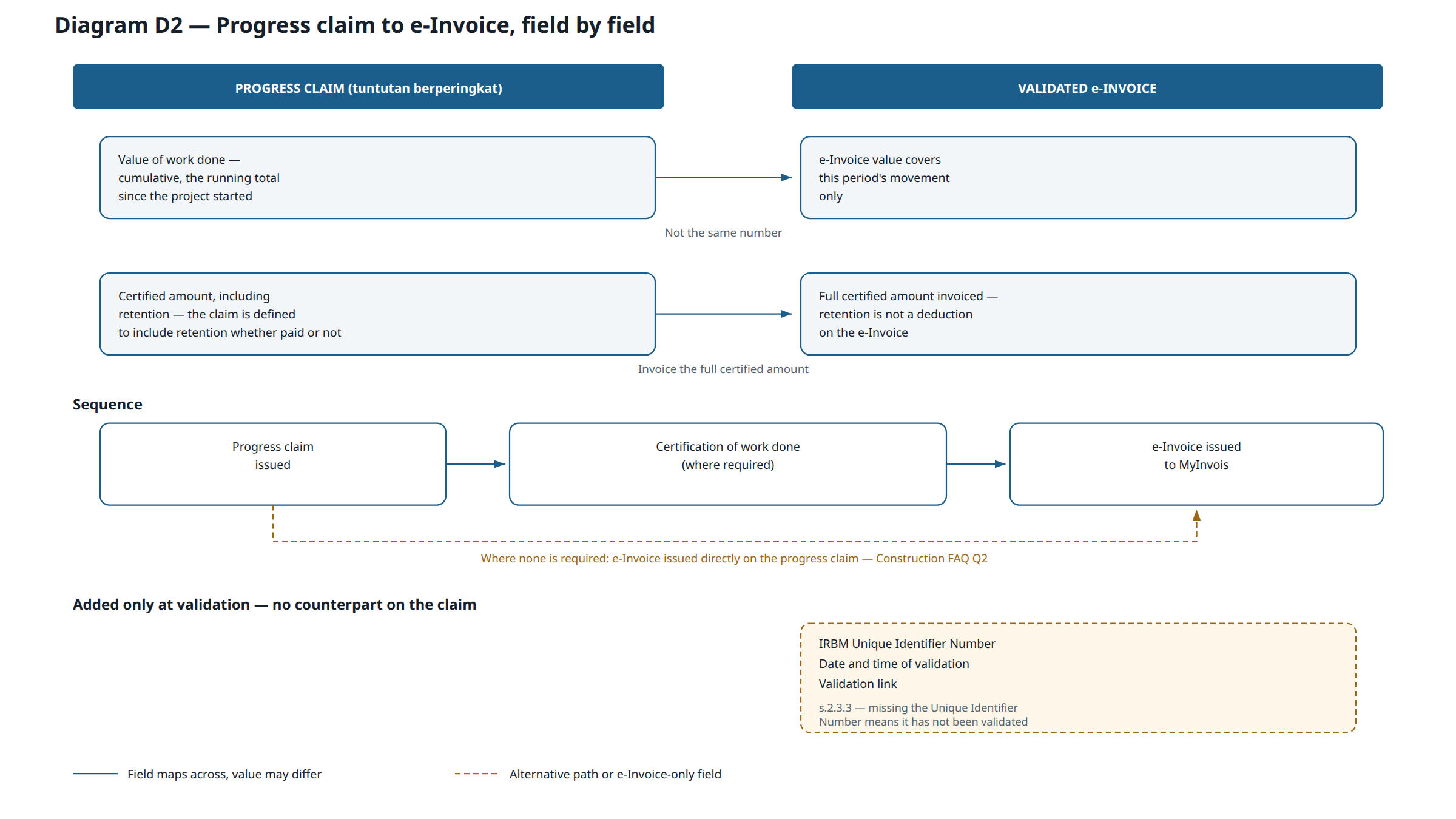
Two things trip people up. The value of work done on a claim is usually cumulative, the running total since the project started; the e-Invoice covers this period's movement. And retention is not a deduction on the e-Invoice — invoice the full certified amount.
Most contractors do not know this applies to them. In general, where a buyer does not want an e-Invoice, a supplier may issue a normal receipt and aggregate a month of them into one consolidated e-Invoice, submitted within seven calendar days after month end — e-Invoice Specific Guideline (Version 4.8), 7 July 2026, s.3.6.1 and s.3.6.2.
That option is closed to you. Section 3.7.1 requires taxpayers in certain listed activities to issue an e-Invoice for each transaction and to obtain the buyer's details. Table 3.6 row 4 reads: "Construction contractor undertaking construction contract, as defined in the Income Tax (Construction Contracts) Regulations 2007." Row 7 catches any single transaction exceeding RM10,000, effective 1 January 2026.
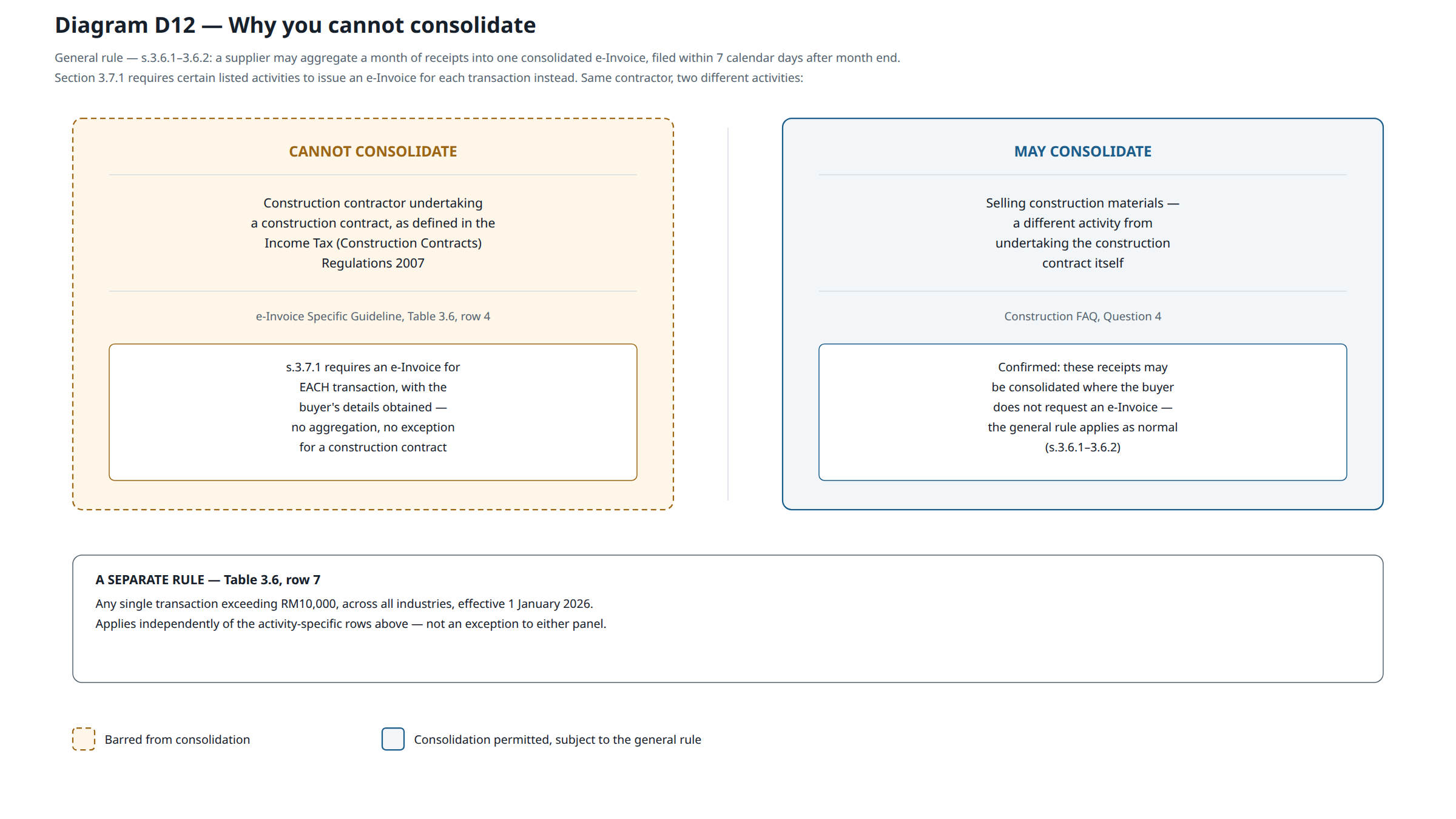
One distinction looks like a contradiction and is not. Row 4 bars consolidation for a contractor undertaking a construction contract; selling construction materials is a different activity, and the construction FAQ at Question 4 confirms those receipts may be consolidated where the buyer does not request an e-Invoice.
Start from the general rule, because most mistakes here come from not knowing it. Under the e-Invoice Specific Guideline (Version 4.8), 7 July 2026, s.8.1, when a sale is concluded the e-Invoice is issued by the supplier, recognising the supplier's income and serving as the buyer's record of the expense. When you pay a subcontractor, the subcontractor is the supplier. The subcontractor issues the e-Invoice. You collect it.
Self-billing, where the buyer issues it instead, is the exception and a closed list. Section 8.3 enumerates the circumstances at (a) to (i), and the word "subcontractor" appears nowhere in it. The only two entries that could catch one are 8.3(b), goods sold or services rendered by foreign suppliers, and 8.3(f), transactions with individuals not conducting a business. A Malaysian business subcontractor is neither.
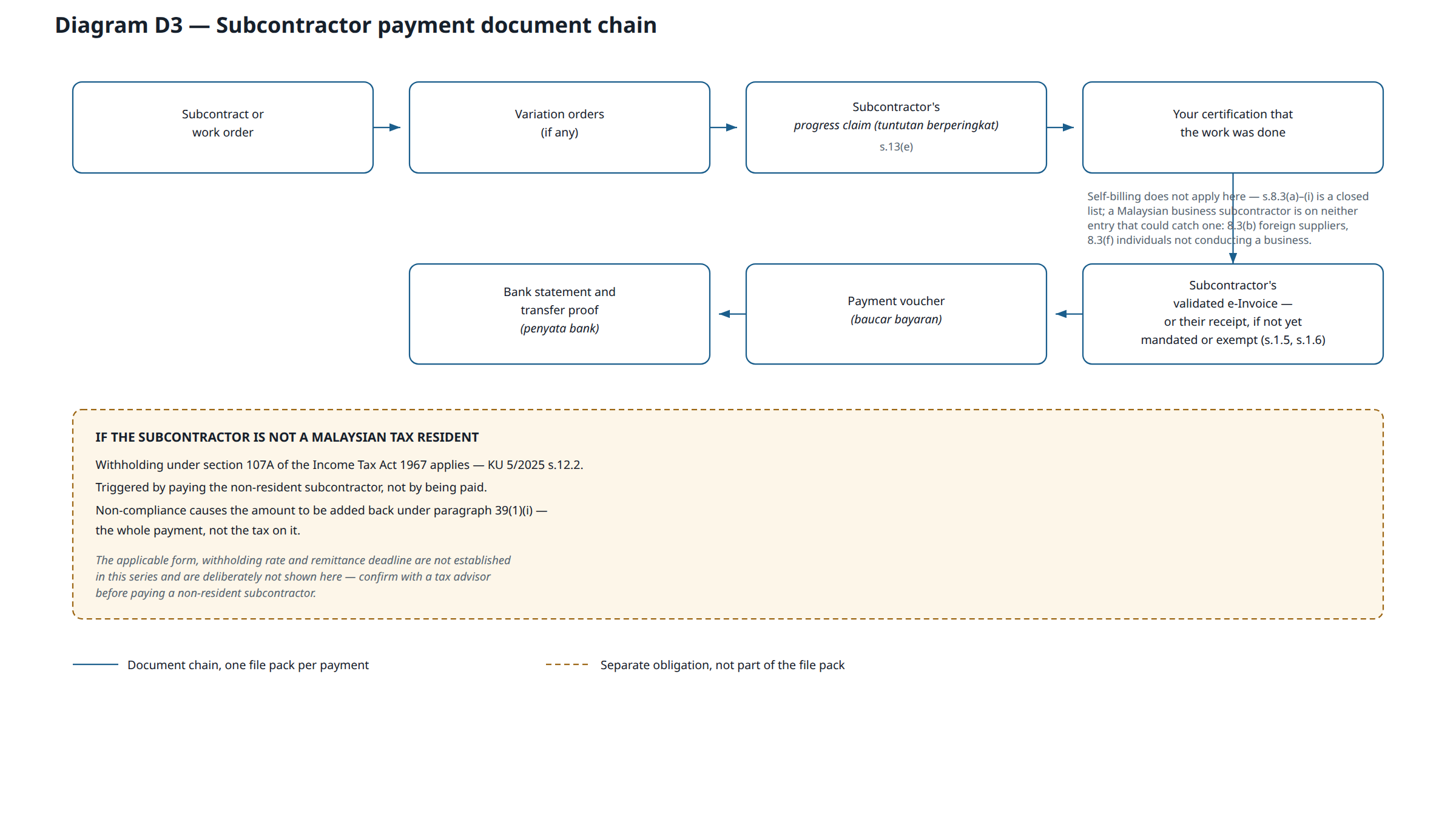
Here is the misunderstanding that causes the most wasted work. A supplier not yet within a mandated implementation phase is not a self-billing trigger. The e-Invoice Guideline (Version 4.8), 30 August 2026, s.1.5, is explicit that the obligation lies with the supplier, and that during the transitional period a taxpayer may receive either a normal receipt, where the supplier has yet to implement e-Invoice, or a validated e-Invoice. Likewise, where a supplier is exempt under s.1.6.1, s.1.6.2 states the receipts they issue are used as proof of expense. Neither case appears in the s.8.3 list.
One payment gets one file pack: the subcontract or work order, any variation orders, their progress claim, your certification that the work was done, their validated e-Invoice — or their receipt where they are not yet mandated or exempt — the payment voucher and the bank transfer proof. The last three are most often missing.
Retention is why the invoice and the bank statement disagree, and mishandling it moves income into the wrong year of assessment.
Take a certified progress claim of RM100,000 with 10% retention. The payer holds back RM10,000 and transfers RM90,000. A beginner records RM90,000 of income, because that is what arrived. It is wrong.
KU 5/2025 s.3.5 defines a progress claim as any amount claimed for work carried out under the contract including the retention amount, whether paid or not. Section 11.5.4 then states that for income tax purposes the progress claim amount, including any retained money that is receivable, is included in the contractor's gross income on the date the claim is issued to obtain payment — not when the money is received. So RM100,000 goes into income that period; the RM10,000 is income already earned, simply not yet handed over.
| Line | Amount | What it is |
|---|---|---|
| Certified progress claim | RM100,000 | The amount the e-Invoice is issued for |
| Retention held by the payer | RM10,000 | Withheld under the contract, not deducted from the invoice |
| Cash received | RM90,000 | What the bank statement shows |
| Gross income recognised | RM100,000 | On the date the claim was issued — KU 5/2025 s.11.5.4 |
The retention percentage above is illustrative. Rates are set by the contract, commonly 5% or 10% in Malaysian practice; no ruling fixes them. The ruling fixes the treatment, not the rate.
KU 5/2025 s.11.5.3 notes retention money is generally held for around six months after completion, and is not paid until the contract's conditions for release are met — so it sits on the books long after a project looks finished. And because you are a subcontractor on some projects, retention runs both ways at once: held from you on one job, held by you on another. Each needs its own record and release date.
Each of these traces to something LHDN has said in writing.
You now know what each document is, who issues it and what it proves. The other half of the job is having somewhere to put them. Part two covers the filing system: the folder structure, how to put the project role into the project code so main-contract and subcontract work stay distinguishable without two trees, how to name every file the same way, and what to do with a bill naming no project.
On the date the claim is issued to obtain payment, not the date the money is received. KU 5/2025 s.11.5.4 includes the progress claim amount, together with any retention money receivable, in the contractor's gross income at the date of issue. Recording it when the bank is credited understates income in that year.
The subcontractor does. Under the e-Invoice Specific Guideline (Version 4.8), 7 July 2026, s.8.1, the e-Invoice is issued by the supplier, and the subcontractor is the supplier. Self-billing is limited to the closed list at s.8.3(a) to (i), and a Malaysian business subcontractor falls into none of them.
No. A supplier being outside the current implementation phase is not one of the self-billed circumstances at s.8.3. The e-Invoice Guideline (Version 4.8), 30 August 2026, s.1.5, states that in the transitional period a buyer may receive either a normal receipt or a validated e-Invoice. Keep the receipt as proof of expense.
No. Table 3.6 row 4 of the e-Invoice Specific Guideline (Version 4.8), 7 July 2026, names "construction contractor undertaking construction contract, as defined in the Income Tax (Construction Contracts) Regulations 2007" among the activities where consolidation is not allowed. Every transaction under a construction contract needs its own e-Invoice, with the buyer's details.
The documents are the same shape in both directions, so the filing does not change. What changes is that retention is receivable and payable at once, on different projects. One obligation does not mirror: the withholding requirement under KU 5/2025 s.12.2 arises when you pay a non-resident subcontractor, not when you are paid.
Every document that crosses your desk answers one question: what happened, on which project, and when. The progress claim says what was done, the interim certificate what was agreed, the e-Invoice what was billed, the payment voucher and bank proof that the money moved. The Certificate of Practical Completion and the Final Account close the job out.
Two things are worth carrying away above all. Income is recognised when the claim is issued, retention included. And the e-Invoice rules for construction are stricter than the general rules, not looser — no consolidation, and the subcontractor issues their own invoice.
Ashraf Ibn Zelt writes on Malaysian tax compliance and bookkeeping for Zelt Digital, an accounting and tax services platform serving SMEs and professional firms with LHDN compliance, e-Invoice implementation, payroll and CFO advisory across Malaysia. Visit zelt.digital to learn more.