Construction Company Documentation Requirements in Malaysia
A
Ashraf Ibn Zelt
4 September 2026
20 min read
#construction#lhdn#compliance#record-keeping#tax-audit#malaysian-tax
Picture made with AI
Ashraf Ibn Zelt
4 September 2026
What LHDN requires a Malaysian construction company to hold, why every contract needs its own accounts, and what the gaps cost when they are found.
Last reviewed: 4 September 2026
Documentation is usually sold to directors as insurance: do the tidy thing now, avoid the painful thing later. That framing is wrong here.
The central piece of record-keeping in a construction company was never optional. KU 5/2025 s.11.3.4 requires a construction expenditure account for each contract, kept separately and prepared for every year of assessment, wherever two or more contracts run at once. Not at completion. Not when audited. Every year, for every live contract.
The work is already on your books as an obligation; what you are deciding is when it gets done. One company codes each bill to a project as it arrives and spends the year end adding up. The other spends it deciding which pile each bill belonged to, a year after the site agent who knew has left.
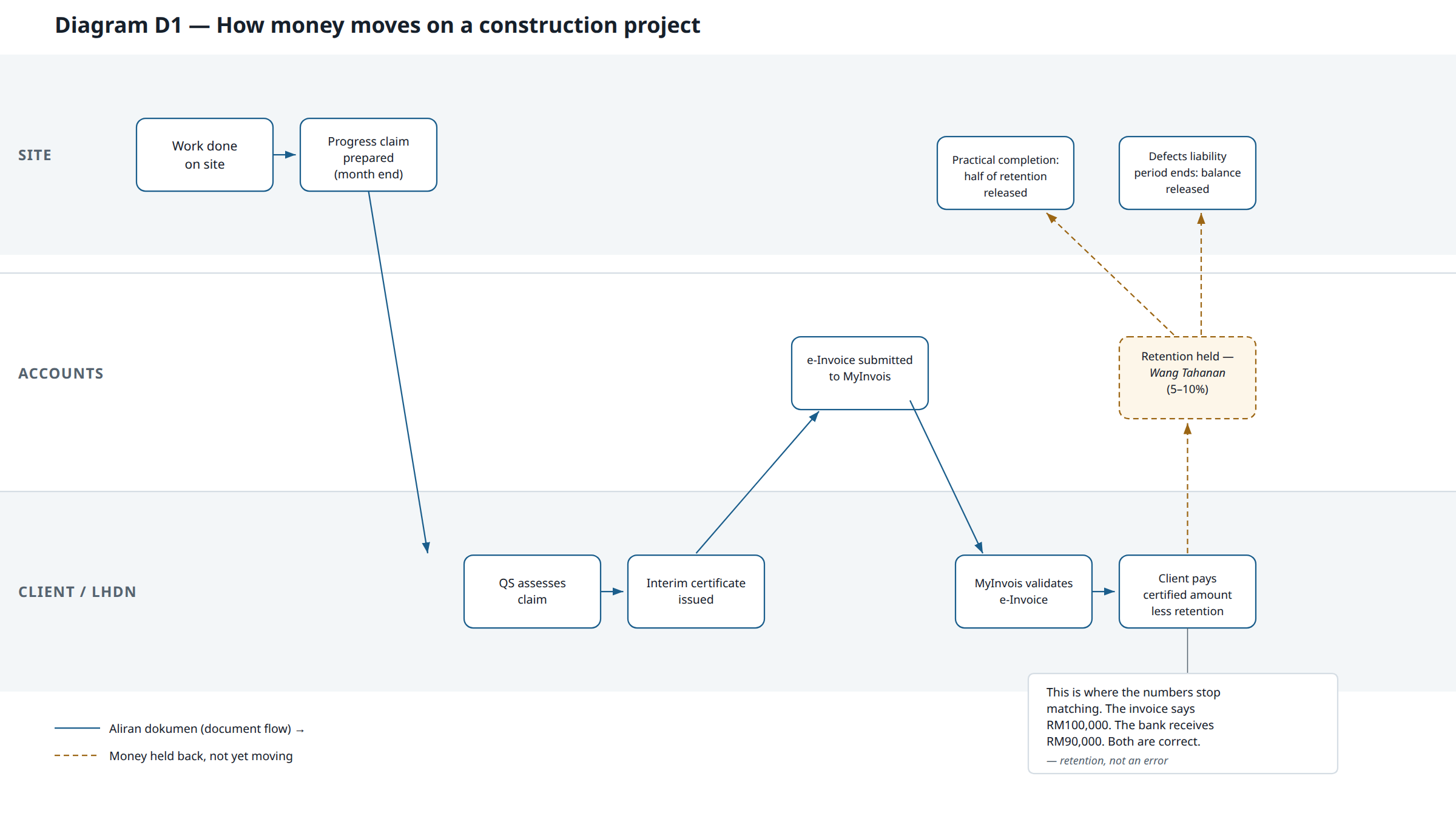
Work is done in March, claimed in April, certified in May, paid in June, and part is not paid until a year after handover. The invoice says RM100,000, the bank receives RM90,000, and both are correct.
General information, not tax or legal advice. Consult a qualified Malaysian tax advisor.
Nothing in the sources behind this article says a construction company is audited more often than one in any other sector, and you should be sceptical of anyone who tells you so. What they show is that construction is dealt with separately, in writing, in four places.
Its own public ruling. Kontrak Pembinaan, Ketetapan Umum No. 5/2025, second edition, issued 9 December 2025, replacing KU No. 2/2009.
Its own source-of-income rule. Section 5, Punca Pendapatan Berasingan Kontrak Pembinaan, treats each construction contract as a separate and distinct source of income. That is why one account for "the construction business" does not answer the question LHDN asks.
Its own bookkeeping mandate. Section 11.3.4 requires the per-contract accounts; s.11.3.5 requires a cost belonging to another contract to be taken back out.
Its own audit information list. Section 13 enumerates what is required when preparing a contractor's accounts for review or examination, and s.14 records that the document list at s.13(a)(i) to (v) is new in this second edition.
Construction is named in the e-Invoice rules too. Row 4 of Table 3.6 of the e-Invoice Specific Guideline reads "Construction contractor undertaking construction contract, as defined in the Income Tax (Construction Contracts) Regulations 2007".
None of that is about frequency. It is about specificity: the questions are construction questions, published in advance.
Directors meet this as five demands from five directions and conclude they are funding five systems. They are not. The same documents feed all five, which is the argument for filing each one properly once.
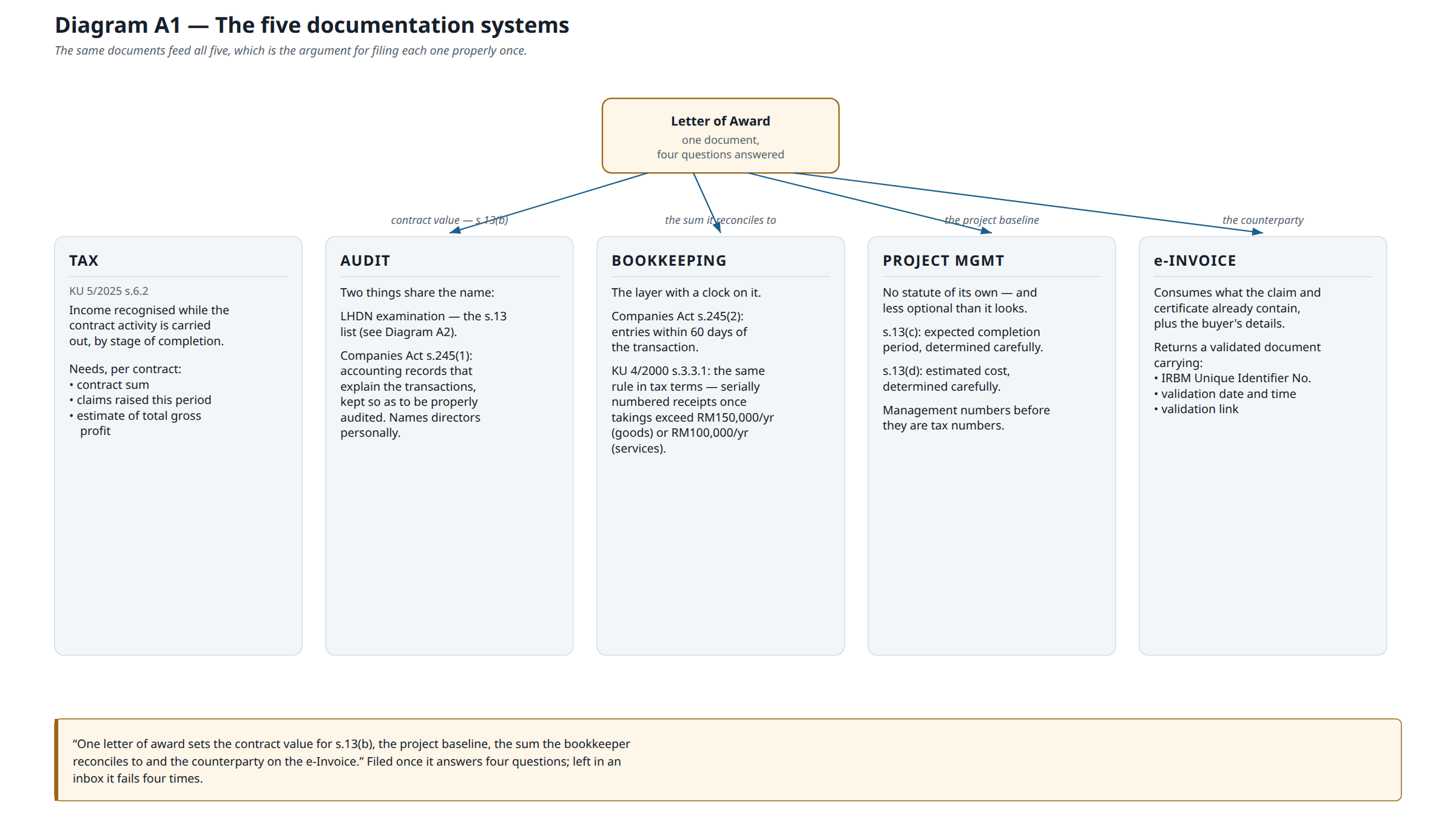
KU 5/2025 s.6.2 requires income to be recognised while the contract activity is carried out, by reference to the stage of completion at the date of the statement of financial position. That takes a contract sum, the claims raised in the basis period and an estimate of total gross profit — per contract.
Two things wear the name. Examination by LHDN, governed by the s.13 list below. And the Companies Act duty behind your statutory accounts: s.245(1) requires the directors and managers of a company to cause accounting records to be kept that sufficiently explain the transactions and financial position, and kept so as to be conveniently and properly audited. It names directors personally.
The layer with a clock on it. Companies Act 2016 s.245(2) requires entries within sixty days of the completion of the transaction. KU 4/2000 s.3.3.1 says the same in tax terms, names the supporting documents, and requires serially numbered receipts once gross takings exceed RM150,000 a year from goods or RM100,000 from services.
The only one with no statute behind it, and less optional than it looks: s.13(c) requires the expected completion period of each contract to be determined carefully, and s.13(d) the estimated cost. Management numbers before they are tax numbers.
Consumes what the claim and the certificate already contain, plus the buyer's details, and returns a validated document carrying an IRBM Unique Identifier Number, a validation date and time and a validation link.
One letter of award sets the contract value for s.13(b), the project baseline, the sum the bookkeeper reconciles to and the counterparty on the e-Invoice. Filed once it answers four questions; left in an inbox it fails four times.
Section 13 states what is required, for review or audit examination, when preparing accounts and statements for a construction contractor. It splits in two.
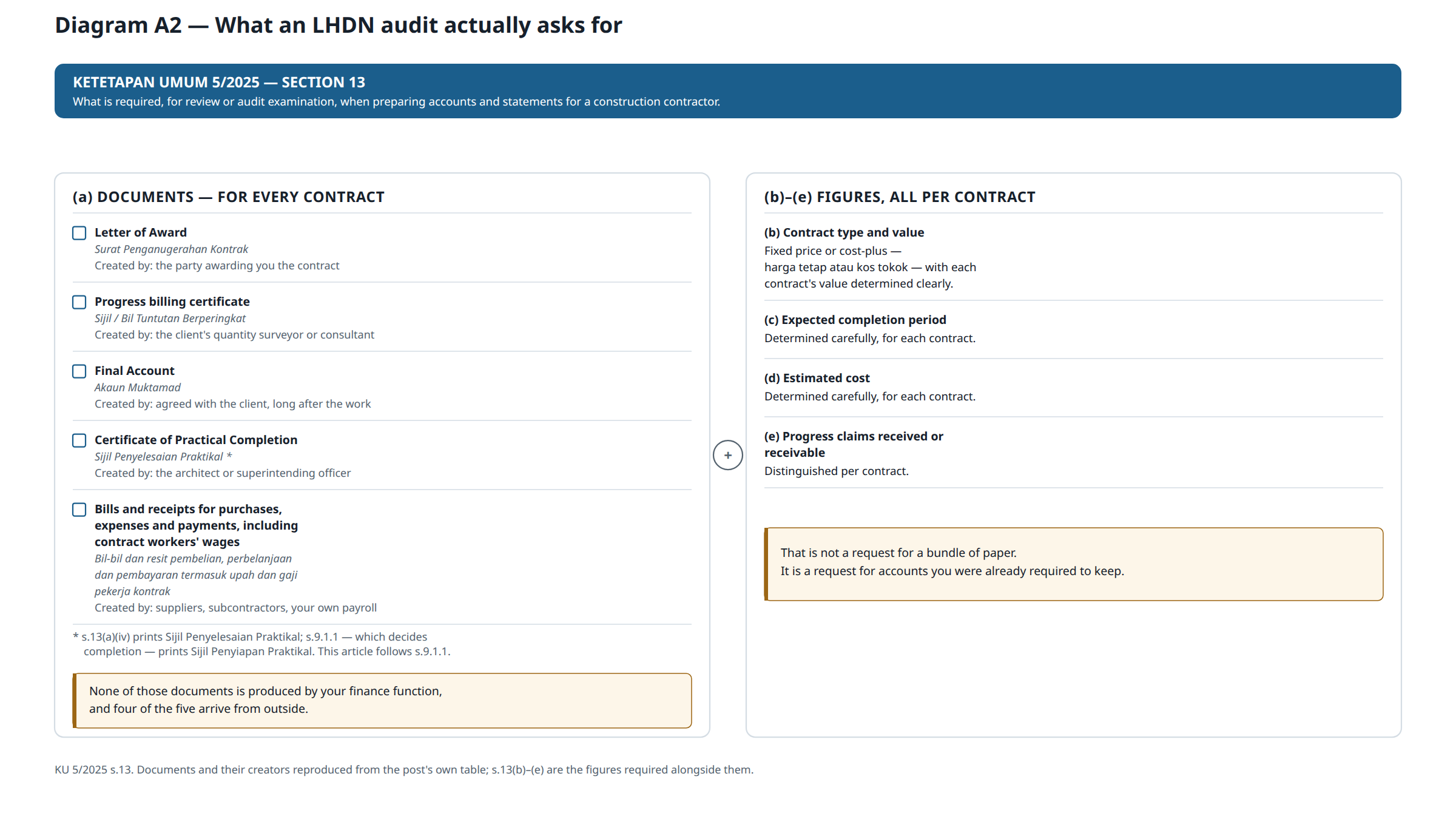
The first limb, s.13(a), lists appropriate documents for every contract carried out.
| Required at s.13(a) | The ruling's term | Who creates it |
|---|---|---|
| Letter of Award | Surat Penganugerahan Kontrak | The party awarding you the contract |
| Progress billing certificate | Sijil / Bil Tuntutan Berperingkat | The client's quantity surveyor or consultant |
| Final Account | Akaun Muktamad | Agreed with the client, long after the work |
| Certificate of Practical Completion | Sijil Penyelesaian Praktikal | The architect or superintending officer |
| Bills and receipts for purchases, expenses and payments, including contract workers' wages | Bil-bil dan resit pembelian, perbelanjaan dan pembayaran termasuk upah dan gaji pekerja kontrak | Suppliers, subcontractors, your own payroll |
The ruling is not consistent with itself on the fourth row. Section 13(a)(iv) prints Sijil Penyelesaian Praktikal, reproduced above as printed; s.9.1.1, the paragraph that decides when a contract is complete, prints Sijil Penyiapan Praktikal. This article uses the s.9.1.1 form in its own prose.
Read the last column again. None of those documents is produced by your finance function, and four of the five arrive from outside at moments when nobody is thinking about a tax file. Uncaptured, they are recovered by asking a client's consultant for a certificate issued four years ago.
The second limb is figures, all per contract. Section 13(b) requires the contract type to be stated — the ruling's examples are fixed price or cost-plus, harga tetap atau kos tokok — with each contract's value determined clearly. Section 13(c) requires the expected completion period and s.13(d) the estimated cost, both determined carefully, and s.13(e) requires progress claims received or receivable to be distinguished per contract.
That is not a request for a bundle of paper. It is a request for accounts you were already required to keep.
Three failures with written consequences. The ringgit figures are illustrative; the treatment is not.
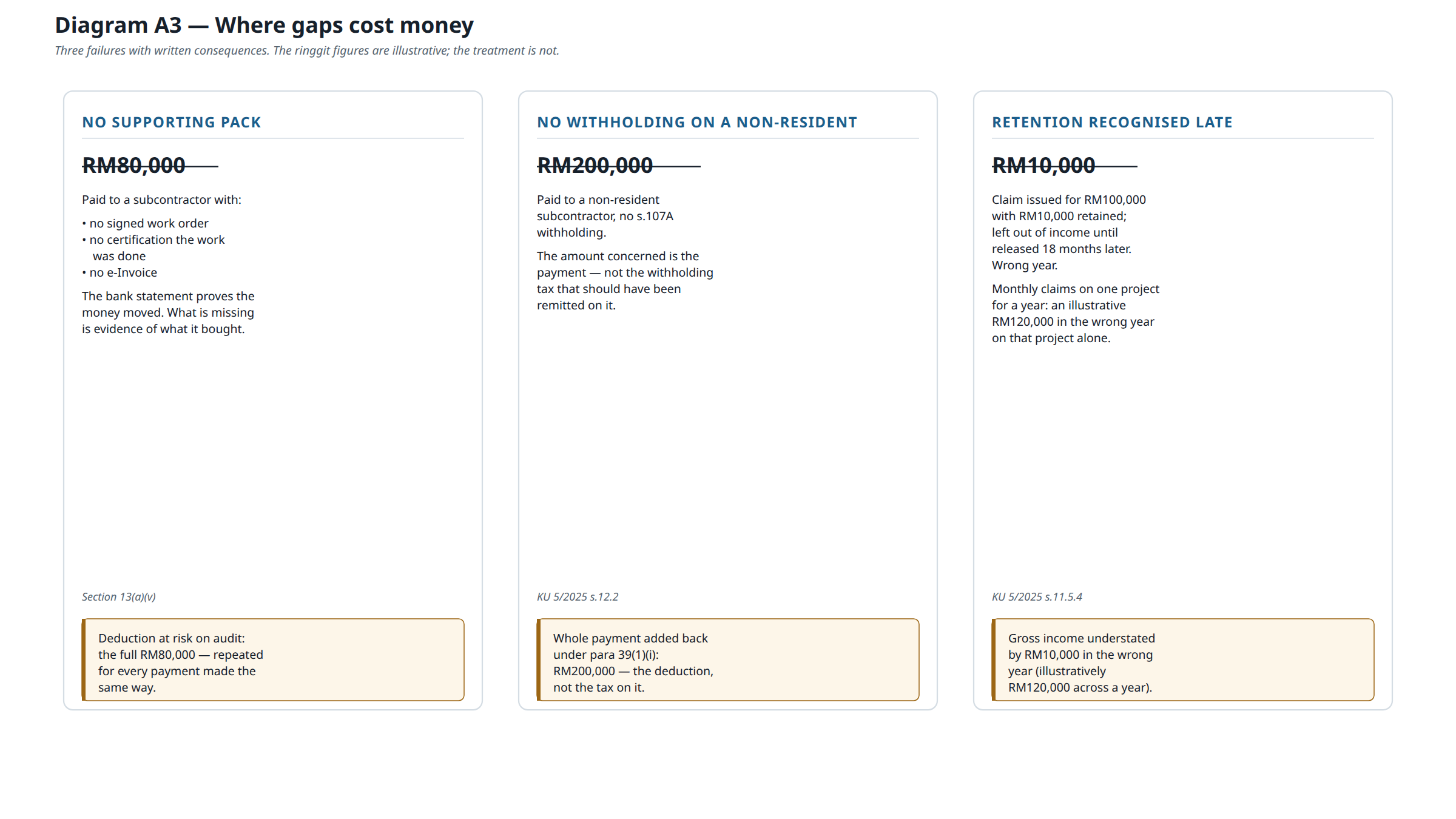
Illustratively, RM80,000 paid with no signed work order, no certification that the work was done and no e-Invoice from the subcontractor. The bank statement proves the money moved; what is missing is evidence of what it bought. Section 13(a)(v) requires bills and receipts for purchases, expenses and payments — including contract workers' wages — for every contract. The exposed deduction is the full RM80,000, repeated for every payment made the same way.
KU 5/2025 s.12.2 states that a construction contractor subcontracting work to a non-resident contractor must comply with section 107A of the Income Tax Act 1967, and that non-compliance causes the amount concerned to be added back in the computation under paragraph 39(1)(i).
The amount concerned is the payment. Illustratively, on RM200,000 paid without withholding, what is lost is the deduction for the whole RM200,000 — not the withholding tax that should have been remitted on it. The cash has already left; the deduction goes too. Anyone assuming the downside is "the tax we should have deducted, plus a penalty" is understating it by an order of magnitude.
Section 107A is one-directional: it bites when you pay a non-resident, not when a Malaysian main contractor pays you.
Illustratively, a claim is issued for RM100,000 with RM10,000 retained, and the RM10,000 is left out of income until it is released eighteen months later. Wrong year. KU 5/2025 s.11.5.4 provides that the progress claim amount, including any money retained under the contract that is receivable, enters gross income at the date the claim is issued to obtain payment. Section 3.5 defines a progress claim as any amount claimed for work carried out, including the retention amount, whether paid or not.
It is never one entry. Monthly claims on one project for a year put an illustrative RM120,000 in the wrong year on that project alone. From the outside that does not read as a timing convention. It reads as gross income understated.
Everything above rests on one paragraph.
11.3.4 Jika terdapat dua atau lebih kontrak dijalankan secara serentak, perbelanjaan pembinaan tersebut hendaklah ditunjukkan secara berasingan. Akaun perbelanjaan pembinaan bagi setiap kontrak hendaklah disimpan secara berasingan dan mesti disediakan untuk setiap TT.
Translation: where two or more contracts are carried out at the same time, that construction expenditure must be shown separately. The construction expenditure account for each contract must be kept separately and must be prepared for every year of assessment. KU 5/2025 s.11.3.4. TT is tahun taksiran, the year of assessment.
Three words are easy to skim. Separately — not merged and split apart on a spreadsheet in December. Each contract — not one account for the division. Every year of assessment — the middle years included.
Section 11.3.5 is the enforcement half: a cost belonging to another contract must be removed in arriving at the allowable construction expenditure carried forward. Section 5 is the reason: each contract is a separate and distinct source of income, and two sources can no more share an account than two businesses could.
Set that against s.13(b) to (e) and the circle closes: the auditor asks for exactly what those accounts contain. A company keeping them answers s.13 from its own books in an afternoon. A company not keeping them is out of compliance with s.11.3.4, whether or not anyone ever asks. Part three covers how the accounts are built.
Three instruments, three periods, three starting events, and they do not reconcile.
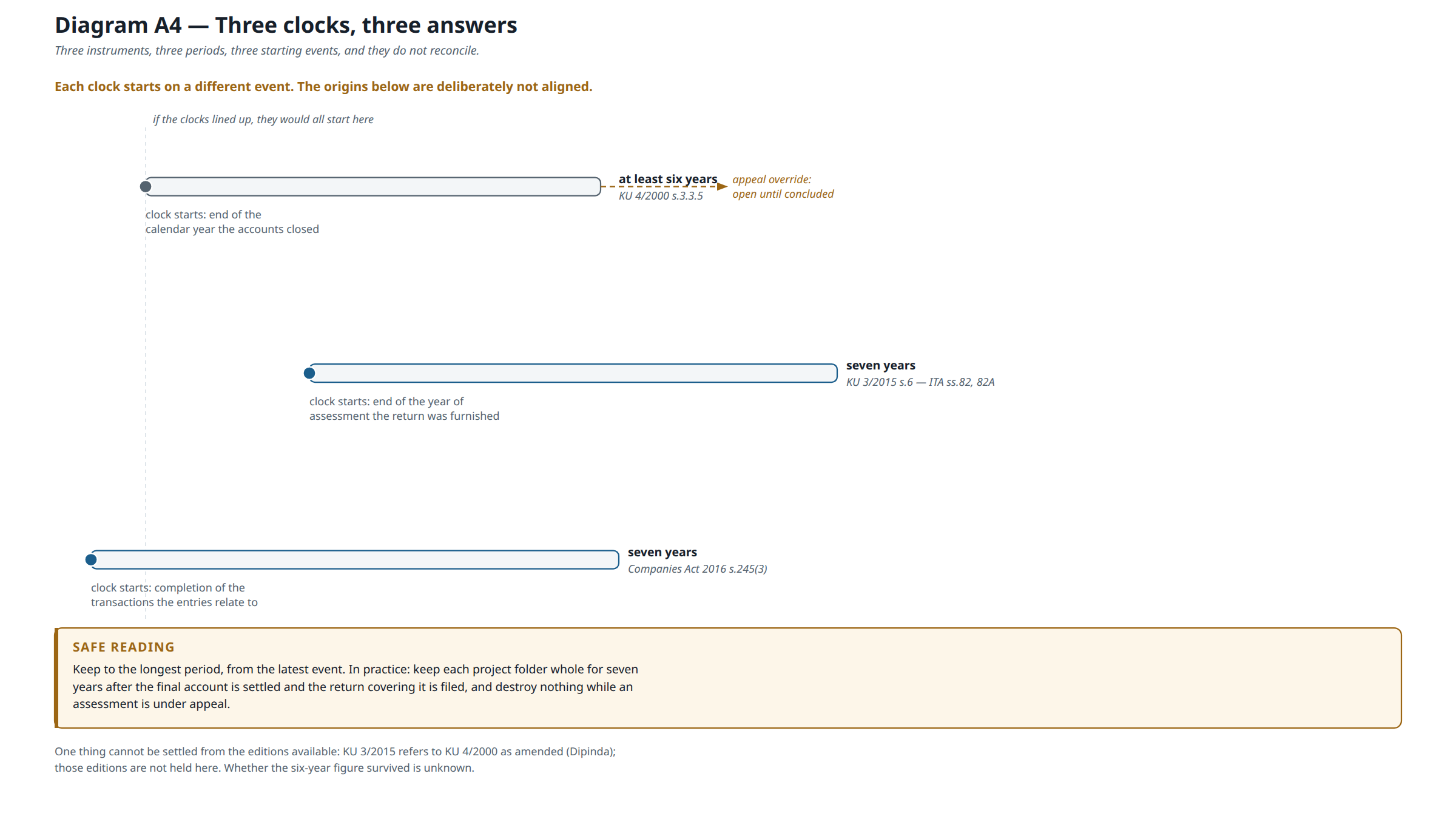
| Instrument | Period | The clock starts from |
|---|---|---|
| KU 4/2000 s.3.3.5 | At least six years | The date of the end of the calendar year in which the accounts are closed |
| KU 4/2000 s.3.3.5, appeal override | Until the appeal is concluded | An appeal against an assessment |
| KU 3/2015 s.6, citing ITA ss.82 and 82A | Seven years | The end of the year of assessment in which the return was furnished |
| Companies Act 2016 s.245(3) | Seven years | Completion of the transactions or operations to which the entries relate |
The Companies Act clock is the awkward one, running per transaction rather than per year. On a three-year contract, the first year's transactions complete long before the last.
One thing cannot be settled from the editions available. KU 3/2015 s.6 refers to KU 4/2000, 5/2000 and 6/2000 not as issued in 2000 but as (Dipinda) — amended, and those editions are not held here. Whether the six-year figure survived is unknown, and this article does not pretend otherwise.
Your answer does not depend on resolving it: keep to the longest period, from the latest event. In practice, keep each project folder whole for seven years after the final account is settled and the return covering it filed, and destroy nothing while an assessment is under appeal.
The penalties are worth knowing but are not the reason to comply. KU 4/2000 s.3.4.2 provides for a fine of not less than RM200 and not more than RM2,000, or imprisonment not exceeding six months, or both. Companies Act 2016 s.245(9) is heavier: a fine not exceeding RM500,000 or imprisonment not exceeding three years, or both, for the company and every officer in contravention.
But the expensive half sits just above the fine. KU 4/2000 s.3.4.1 provides that the chargeable income of the company may be determined at the discretion of the Director General and an assessment raised accordingly. A RM2,000 fine is an irritation. Having your taxable income determined by somebody else, because your own records could not, is unbounded.
Start with the part most contractors do not know, because it names the industry.
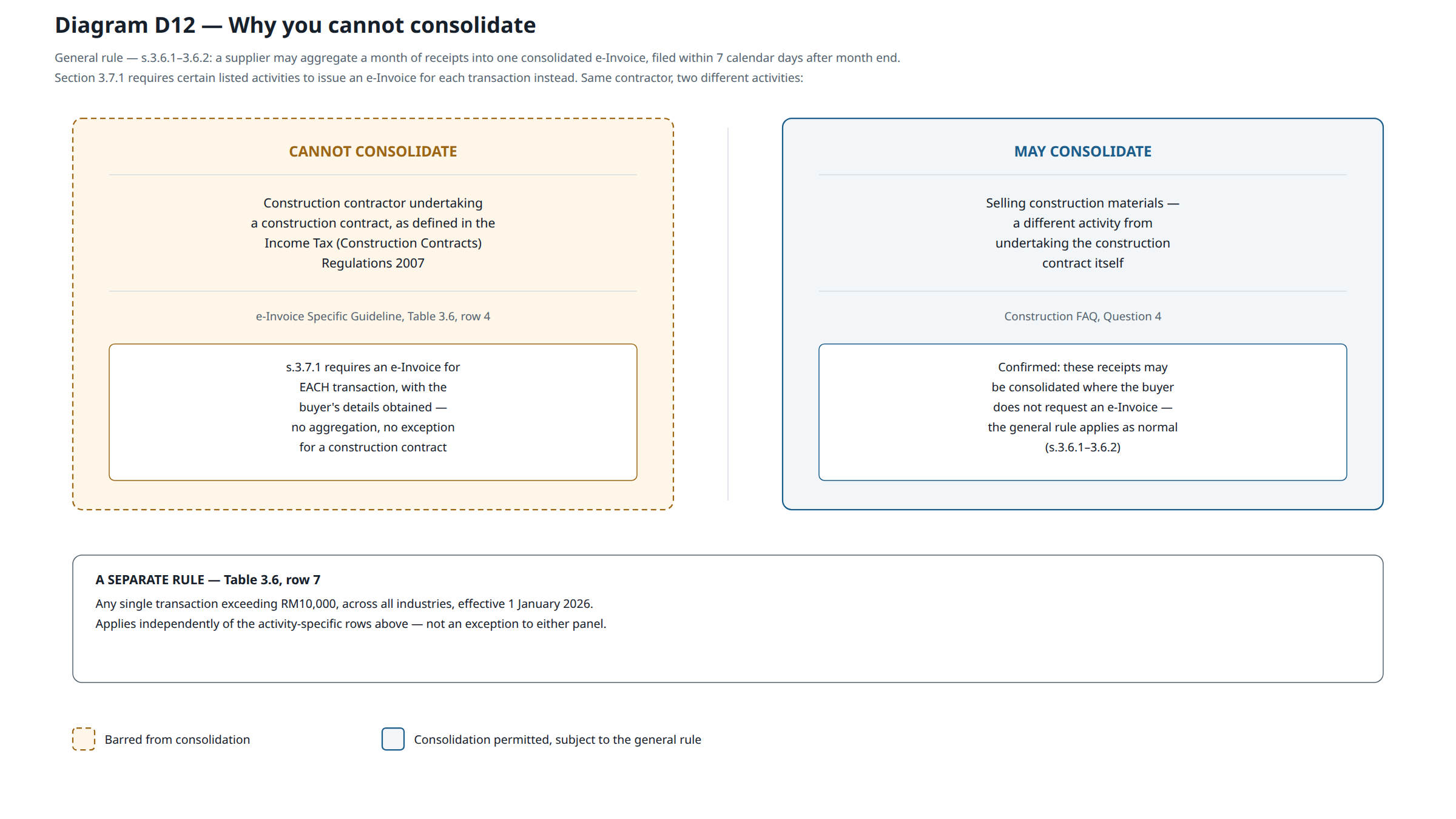
Where a buyer does not require an e-Invoice, the general rule lets the supplier issue a normal receipt and aggregate a month of them into one consolidated e-Invoice, submitted within seven calendar days after the month end — e-Invoice Specific Guideline s.3.6.1 and s.3.6.2. Table 3.6 lists where that is unavailable. Row 4, in full: "Construction contractor undertaking construction contract, as defined in the Income Tax (Construction Contracts) Regulations 2007".
A construction contractor undertaking a construction contract cannot consolidate at all for that activity. Every transaction needs its own e-Invoice, and s.3.7.1 is explicit that this means obtaining the buyer's details for each one — an operating commitment before an accounting one, since somebody must collect counterparty tax data as routine.
Row 7 catches the rest of what you sell, across all industries: "Any single transaction with a value exceeding RM10,000. Note that this will be effective starting 1 January 2026."
The distinction is load-bearing. The Construction Industry FAQ, updated 6 January 2026, allows a company selling construction materials to issue receipts and consolidate them where the buyer does not request an e-Invoice. Selling materials is not undertaking a construction contract: the activity decides the treatment, not the company.
On subcontractors, one point saves needless work. Under s.8.1 of the Specific Guideline the e-Invoice is issued by the supplier, and your Malaysian business subcontractor is the supplier. Self-billing applies only in the closed list at s.8.3(a) to (i), which they are not in. Nor does a supplier outside a mandated phase change that: e-Invoice Guideline s.1.5 confirms you may receive a normal receipt. Keep it; it is not a reason to self-bill.
You do not need to learn a procedure. You need to ask a few questions on a schedule and recognise a bad answer.
| Ask for | How often | A bad answer |
|---|---|---|
| Live contracts with contract sum, contract type and expected completion date | Monthly | One figure for "the construction business" |
| The construction expenditure account for each live contract | Quarterly | A single account, or a spreadsheet built for this meeting |
| How much of last month's supplier cost carried no project code | Monthly | Nobody measures it |
| The retention register — held from you and held by you, with release conditions | Quarterly | Retention netted to one company-level number |
| Section 107A compliance for every non-resident paid this quarter | Quarterly | "We don't use foreign subcontractors", unchecked against the ledger |
| One subcontractor payment, chosen at random, with its complete pack | Quarterly | It takes more than an hour to assemble |
| The updated estimate of total cost for each unfinished contract, and who updated it | Half-yearly | The tender figure, unchanged since award |
| Which project folders may lawfully be destroyed this year, and on what basis | Annually | Anything other than seven years from the latest event |
Three decisions sit behind that table, and only you can make them.
Who attaches the project code, and when. Attached as the invoice arrives, nobody remembers which site the delivery went to. Attached at the purchase order, it is remembered for you.
Who owns the estimated total cost of each contract. Section 13(d) requires it to be determined carefully, and it drives the profit recognised in every year of the contract. Owned by someone with no site knowledge, it will be wrong for years before anyone notices.
Whether the retention register exists. One line per balance: project, the claim, the amount, which direction it runs, and what releases it.
Required. KU 5/2025 s.11.3.4 requires the construction expenditure to be shown separately where two or more contracts run at once, and an account for each contract kept separately and prepared for every year of assessment. Section 5 gives the reason: each contract is a separate and distinct source of income.
Nothing in the sources cited here says so, and this article does not claim it. What they show is differentiated treatment: a dedicated public ruling, a construction-specific audit information list at s.13, and a named row in the e-Invoice consolidation table.
KU 5/2025 s.13, in two limbs. Section 13(a) asks, for every contract, for the Letter of Award, the progress billing certificate, the Final Account, the Certificate of Practical Completion, and bills and receipts for purchases, expenses and payments including contract workers' wages. Sections 13(b) to (e) ask for contract type and value, expected completion, estimated cost and progress claims per contract.
More than the withholding. KU 5/2025 s.12.2 states that non-compliance with section 107A of the Income Tax Act 1967 causes the amount concerned to be added back under paragraph 39(1)(i). The amount added back is the payment itself, so you lose the deduction for a sum already paid out.
It cannot be settled from the editions available. KU 4/2000 s.3.3.5 says at least six years from the end of the calendar year the accounts closed; KU 3/2015 s.6, citing ITA ss.82 and 82A, says seven years from the end of the year of assessment the return was furnished; Companies Act 2016 s.245(3) says seven years after completion of the transaction. KU 3/2015 cites amended (Dipinda) editions that are not held. Keep to the longest from the latest event.
Not for construction contract work. Table 3.6 row 4 of the e-Invoice Specific Guideline (Version 4.8) names a construction contractor undertaking a construction contract as an activity where consolidation is not allowed, so each transaction needs its own e-Invoice with the buyer's details. Row 7 separately removes it for any single transaction over RM10,000, effective 1 January 2026.
The case for a documentation system is not that it feels professional. KU 5/2025 s.11.3.4 already requires a construction expenditure account for each contract, kept separately and prepared for every year of assessment, because s.5 treats each contract as its own source of income. That work is on your books whether or not anybody is watching.
Everything else follows from doing it on a schedule. Section 13 stops being an interrogation and becomes a printout. A subcontractor payment has its pack because the pack was assembled when the payment was made. Retention sits in the right year, and the folder is intact because nobody thinned it.
The decision is smaller than the compliance material makes it look. Not whether to build a system — that is already required. Only whether it runs monthly, or all at once next March.
Ashraf Ibn Zelt writes on Malaysian tax compliance and bookkeeping for Zelt Digital, an accounting and tax services platform serving SMEs and professional firms with LHDN compliance, e-Invoice implementation, payroll and CFO advisory across Malaysia. Visit zelt.digital to learn more.
Related reading: How Long to Keep Accounting Records in Malaysia