A Construction Company Filing System That Survives an Audit
A
Ashraf Ibn Zelt
4 September 2026
22 min read
#construction#bookkeeping#filing#record-keeping#compliance
Picture made with AI
Ashraf Ibn Zelt
4 September 2026
Folder structure, file naming and project codes for a Malaysian contractor — plus the three-way match, and how long records must be kept.
Last reviewed: 4 September 2026
M-TRX02, S-KLCC07 — so it shows up in every filename for free.Part one covered what each document is and who issues it. This part covers the duller half, which is where the money is actually lost: having somewhere to put them.
A shoebox works for eleven months and fails in the twelfth. Somebody asks what a project cost. You have every bill — but a third do not say which site they went to, two suppliers billed three projects on one invoice, and the delivery order that would have settled it never came back from site. So the number gets estimated, and an estimate nobody can trace is both what an auditor finds and what hides a project that lost money.
What follows is one folder tree, one filename convention, one rule for coding bills, one check before paying. Fifteen minutes a week keeps it true.
General information, not tax or legal advice. Consult a qualified Malaysian tax advisor.
Work starts with a quotation you send out, or a tender you submit, and most come to nothing. Keep a single /00-Tenders folder at company level, one subfolder per tender, holding the enquiry, your pricing build-up, the quotation issued and the correspondence.
Then the rule that saves the most retyping in the system: on award, the tender folder becomes the project folder. Rename it to its project code and move it under the contracts branch — do not create a new folder and copy things across. The pricing that won the job stays with the job, which matters when someone later asks why the estimated cost was what it was; Ketetapan Umum No. 5/2025 (KU 5/2025) s.13(d) requires the estimated cost of each contract to be determined carefully.
Tenders that come to nothing stay put — the record of what the company bid and lost.
One tree covers every project, whichever side of the deal you are on.
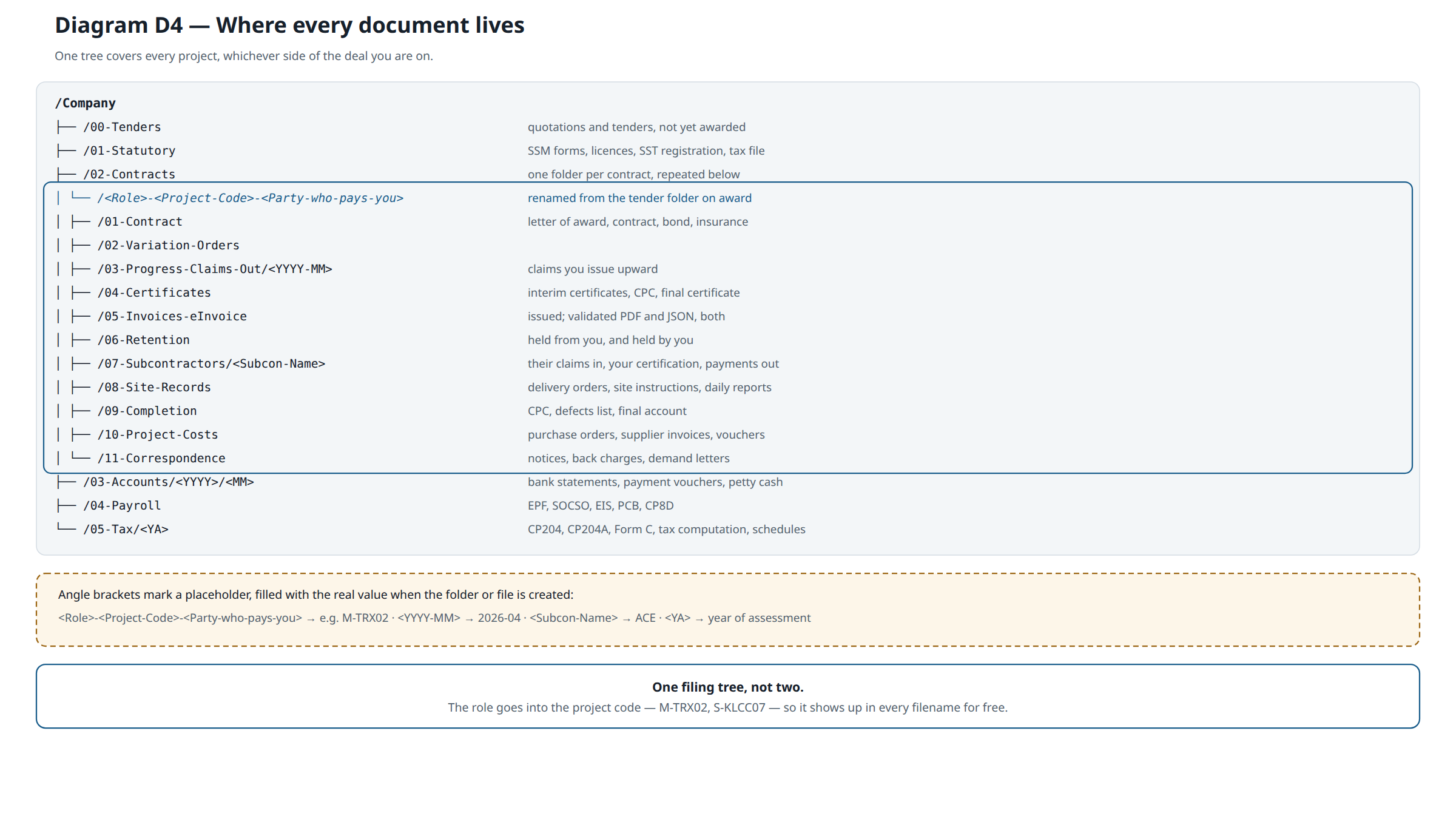
/Company
  /00-Tenders                          quotations and tenders, not yet awarded
  /01-Statutory                        SSM forms, licences, SST registration, tax file
  /02-Contracts
    /<Role>-<Project-Code>-<Party-who-pays-you>
      /01-Contract                     letter of award, contract, bond, insurance
      /02-Variation-Orders
      /03-Progress-Claims-Out/<YYYY-MM>   claims you issue upward
      /04-Certificates                 interim certificates, CPC, final certificate
      /05-Invoices-eInvoice            issued; validated PDF and JSON, both
      /06-Retention                    held from you, and held by you
      /07-Subcontractors/<Subcon-Name> their claims in, your certification, payments out
      /08-Site-Records                 delivery orders, site instructions, daily reports
      /09-Completion                   CPC, defects list, final account
      /10-Project-Costs                purchase orders, supplier invoices, vouchers
      /11-Correspondence               notices, back charges, demand letters
  /03-Accounts/<YYYY>/<MM>             bank statements, payment vouchers, petty cash
  /04-Payroll                          EPF, SOCSO, EIS, PCB, CP8D
/05-Tax/<YA> CP204, CP204A, Form C, tax computation, schedulesFour branches sit outside any project. If a document names a project, it belongs under that project.
One folder per contract, numbered 01 to 11 so branches sort in the order work happens rather than alphabetically. Someone filing at speed picks the right branch faster from a number than a word.
The folder per contract is not tidiness. KU 5/2025 s.11.3.4 requires that where two or more contracts run at the same time, the construction expenditure must be shown separately, and a construction expenditure account for each contract kept separately and prepared for every year of assessment. The tree is the physical form of that requirement.
/03-Accounts is filed by year and month, not by project, because that is how bank statements arrive. It is the reconciling half: every payment voucher in a project folder has a counterpart here, and every bank statement line traces to one project or to overhead.
The company is main contractor on some projects and subcontractor on others. The tempting move is two trees. Do not — it makes a beginner learn two structures, and breaks the first time both roles appear on one job. Put the role in the project code instead.
| Project code | What it means | Who pays you |
|---|---|---|
M-TRX02 | Main contractor, TRX project, contract 02 | The project owner |
S-KLCC07 | Subcontractor, KLCC project, contract 07 | The main contractor above you |
Because the project code appears in every filename, the role becomes visible everywhere at no cost. 2026-03-31_ProgressClaim_M-TRX02_CL-07.pdf says which side of the transaction it is before you open it.
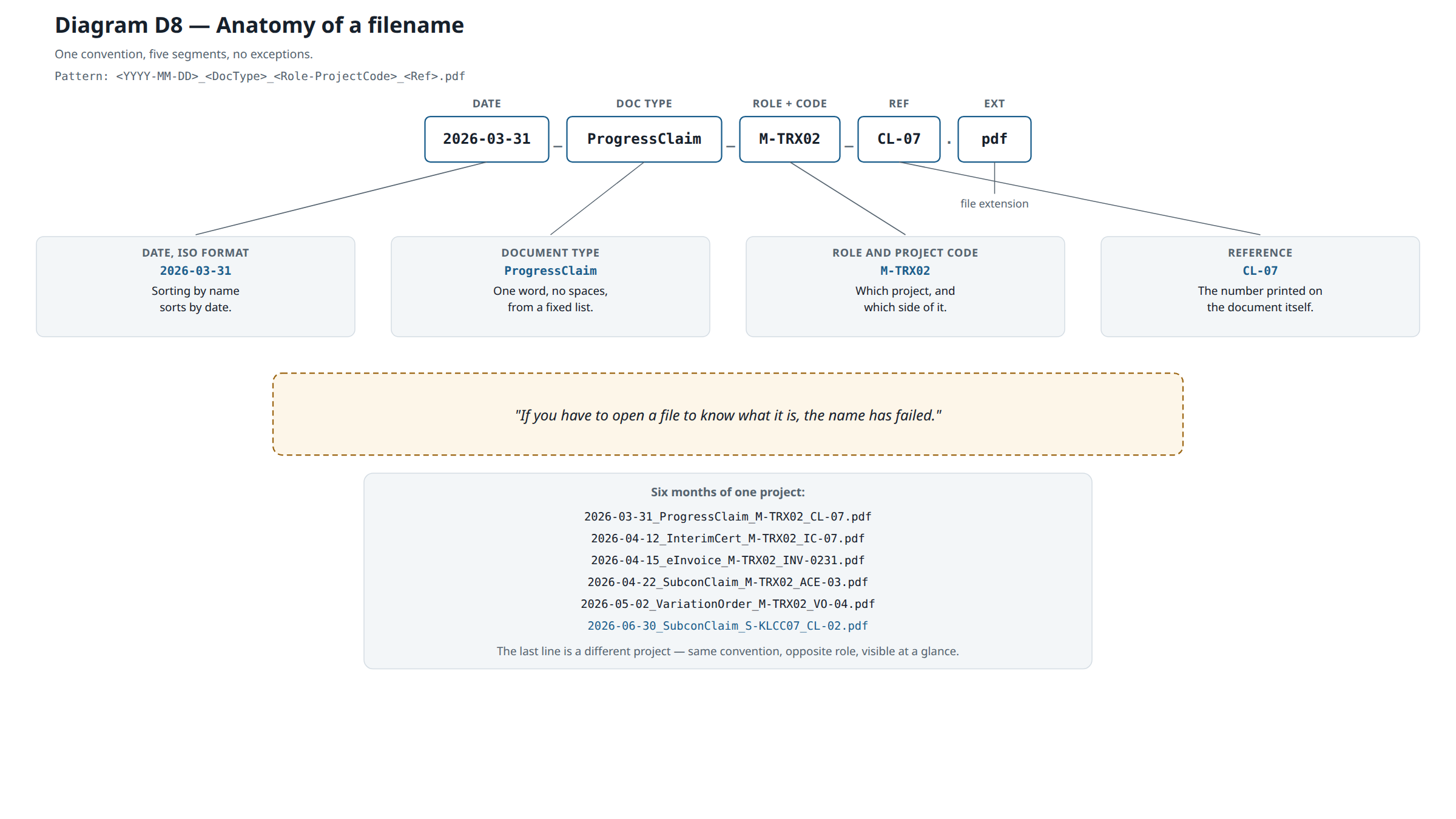
One convention, five segments, no exceptions: <YYYY-MM-DD>_<DocType>_<Role-ProjectCode>_<Ref>.pdf
| Segment | Example | Why |
|---|---|---|
| Date, ISO format | 2026-03-31 | Sorting by name sorts by date |
| Document type | ProgressClaim | One word, no spaces, from a fixed list |
| Role and project code | M-TRX02 | Which project, and which side of it |
| Reference | CL-07 | The number printed on the document itself |
Six months of one project:
2026-03-31_ProgressClaim_M-TRX02_CL-07.pdf
2026-04-12_InterimCert_M-TRX02_IC-07.pdf
2026-04-15_eInvoice_M-TRX02_INV-0231.pdf
2026-04-22_SubconClaim_M-TRX02_ACE-03.pdf
2026-05-02_VariationOrder_M-TRX02_VO-04.pdf
2026-06-30_SubconClaim_S-KLCC07_CL-02.pdf
The last line is a different project, where the company is the subcontractor — same convention, opposite role, visible at a glance. If you have to open a file to know what it is, the name has failed.
A single month on one project produces about a dozen documents, arriving named scan001.pdf, IMG_4471.jpg and WhatsApp Image 2026-04-12 at 3.41 PM.jpeg.
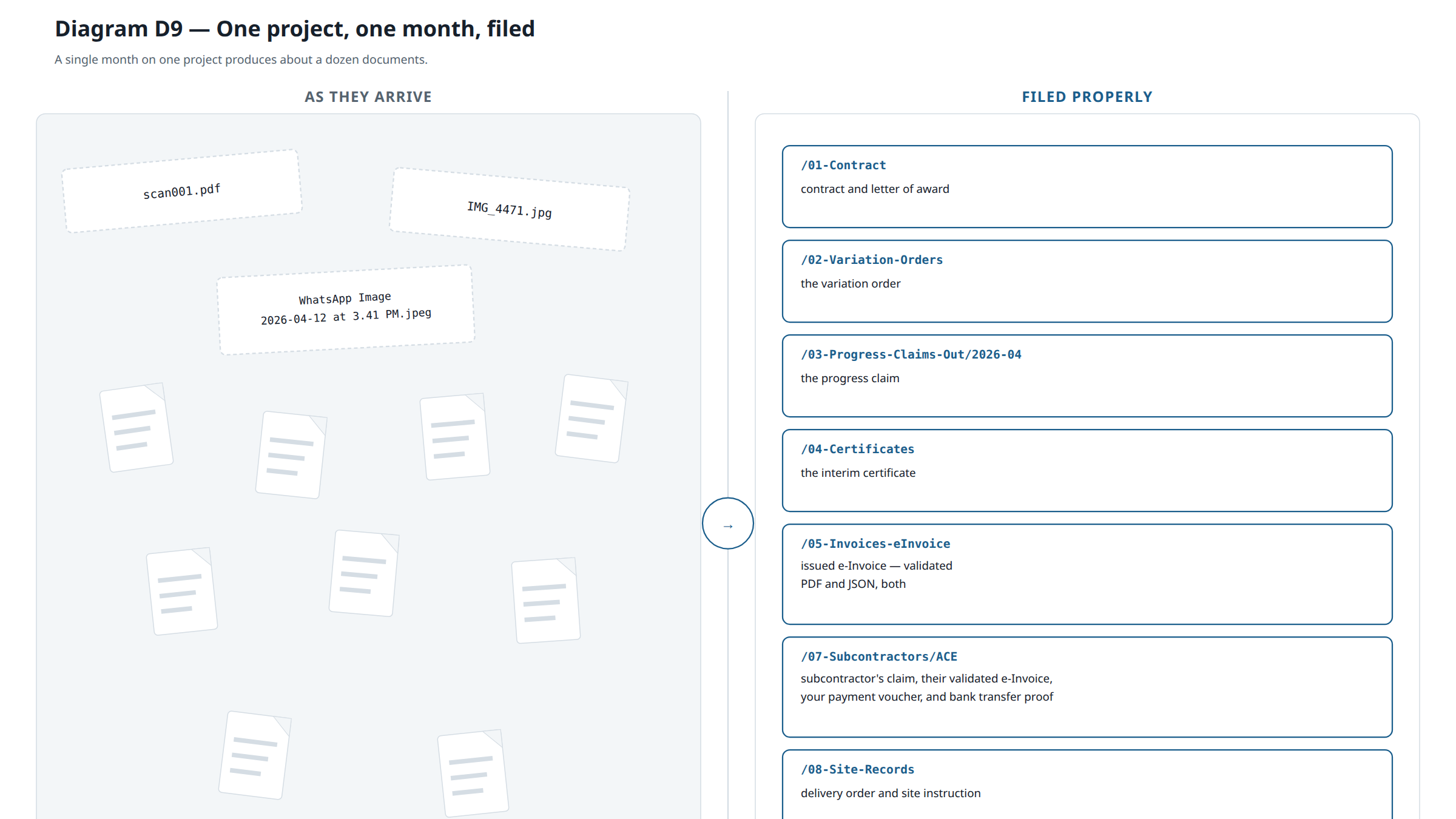
Filed properly the same dozen sits like this: contract and letter of award in /01-Contract; the variation order in /02-Variation-Orders; the progress claim in /03-Progress-Claims-Out/2026-04; the interim certificate in /04-Certificates; the issued e-Invoice, validated PDF and JSON both, in /05-Invoices-eInvoice; the subcontractor's claim, their validated e-Invoice, your payment voucher and the bank transfer proof together in /07-Subcontractors/ACE; the delivery order and site instruction in /08-Site-Records.
Nothing there is extra work — the same twelve documents, named and put away once instead of hunted for twice.
Almost every document type exists in both directions at once. Picture the company between two chains: the party who pays you above, the parties you pay below.
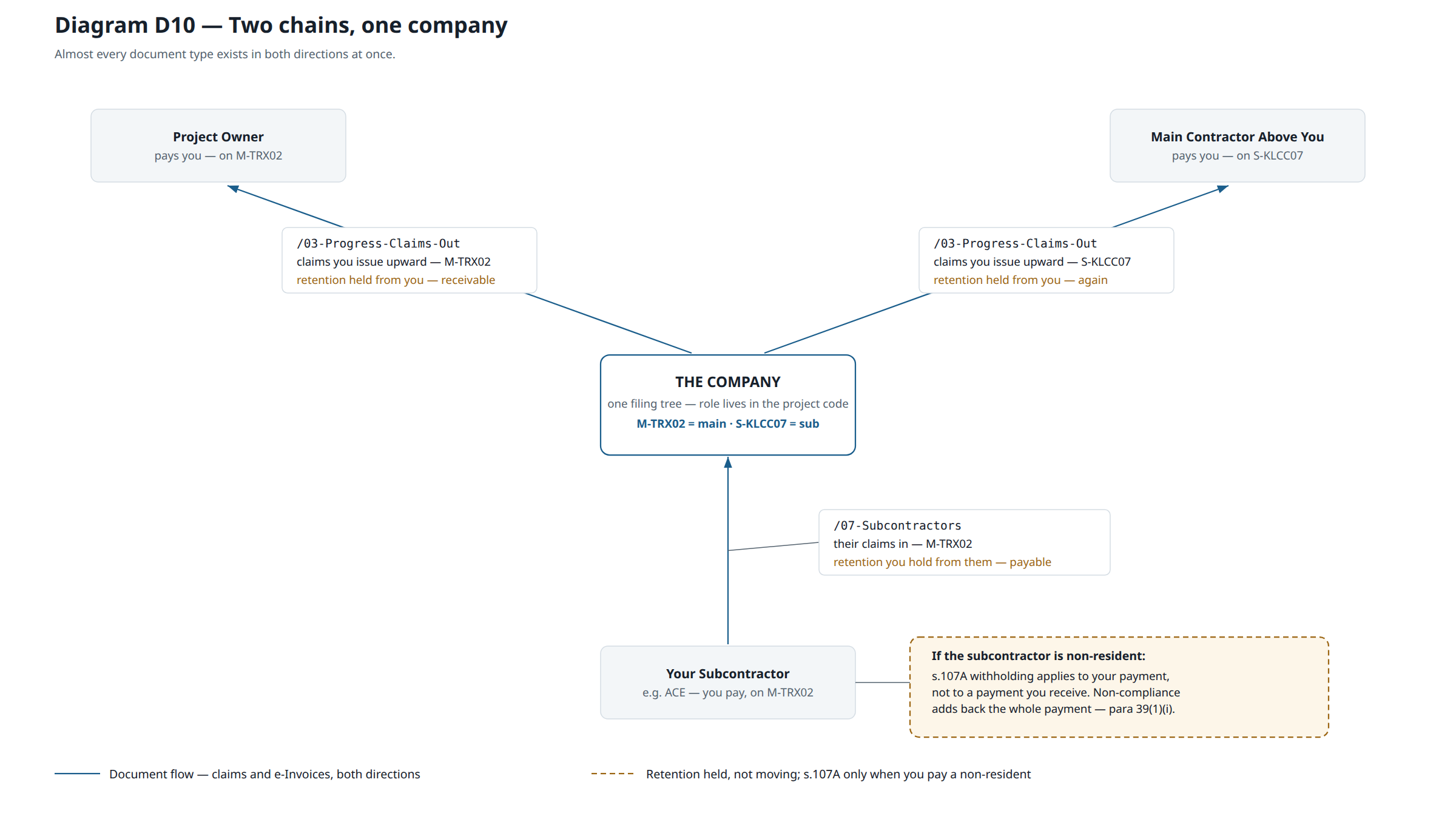
You issue upward to the project owner and receive from subcontractors and suppliers. /03-Progress-Claims-Out holds what you issued; /07-Subcontractors holds what came in. Your claim is income, theirs is cost, and mixing them in one folder is how they end up mixed in the accounts.
Identical, except the party above you is another contractor rather than the owner. Your claims still go out through /03-Progress-Claims-Out, still get certified, still become e-Invoices. Nothing about the filing changes — which is why one tree is enough.
One obligation does not mirror. Withholding under section 107A of the Income Tax Act 1967 is triggered by paying a non-resident, not by being paid. KU 5/2025 s.12.2 requires a contractor who subcontracts to a non-resident contractor to comply with s.107A, and states that non-compliance causes the amount to be added back under paragraph 39(1)(i) — the whole payment, not the tax on it.
On M-TRX02 the owner holds retention from you: a receivable, money already earned. On the same project you hold retention from your own subcontractor: a payable. On S-KLCC07 the main contractor above holds it from you again.
All live at once, on different projects, with different release dates. Each project's /06-Retention folder therefore holds two kinds of paper — what is held from you, and what you hold. A one-line register per project (amount, held by or from whom, the releasing event) is the only way anyone remembers a balance a year after the site goes quiet. It also stops a release payment eighteen months later being booked as income twice, since KU 5/2025 s.11.5.4 already put it into gross income when the claim was issued.
The highest-value habit in the system.
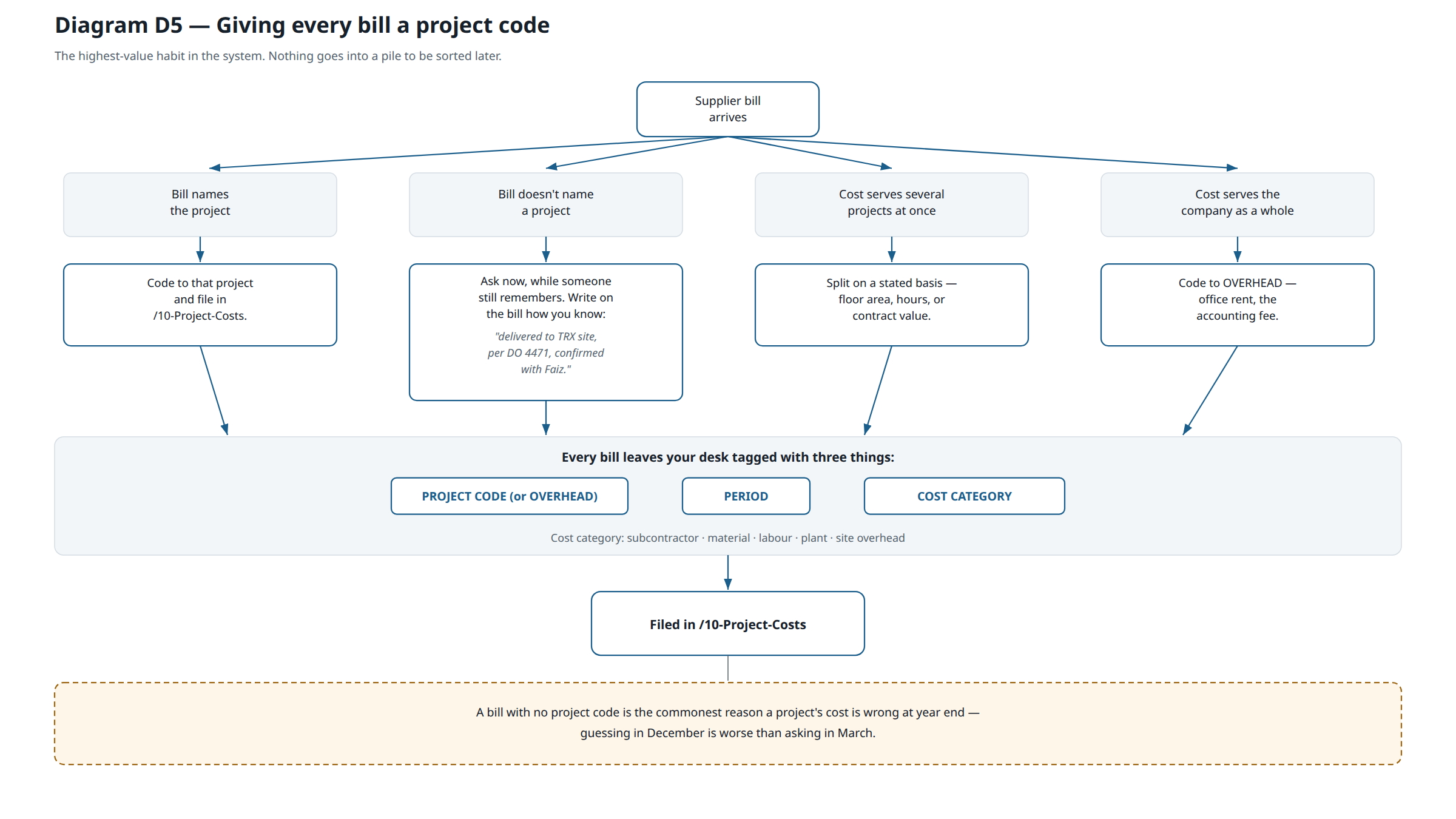
Every bill leaves your desk with three things written on it: a project code, or the word OVERHEAD; the period; and a cost category — subcontractor, material, labour, plant, or site overhead. Nothing goes into a pile to be sorted later.
Code it to that project and file it in /10-Project-Costs. Most material invoices name the delivery site, which is enough.
Ask now, while somebody still remembers, then write on the bill how you know — "delivered to TRX site, per DO 4471, confirmed with Faiz". Ten seconds, and the difference between a coded cost and a guess. A bill with no project code is the commonest reason a project's cost is wrong at year end: guessing in December is worse than asking in March.
Some costs genuinely serve more than one job — a crane hired across two sites, a supervisor covering three. Split them on a stated basis (floor area, hours, or contract value) and write that basis on the bill.
Costs serving the company as a whole — office rent, the accounting fee — go to overhead. Do not force them onto a project; forcing is worse than omitting, because it makes one project's cost wrong in a way nobody can unpick. And a cost posted to the wrong contract must come back out: KU 5/2025 s.11.3.5 requires the construction expenditure account to be adjusted, and where the cost of another contract has been included in it, that cost removed before arriving at the allowable construction expenditure carried forward to the following year of assessment.
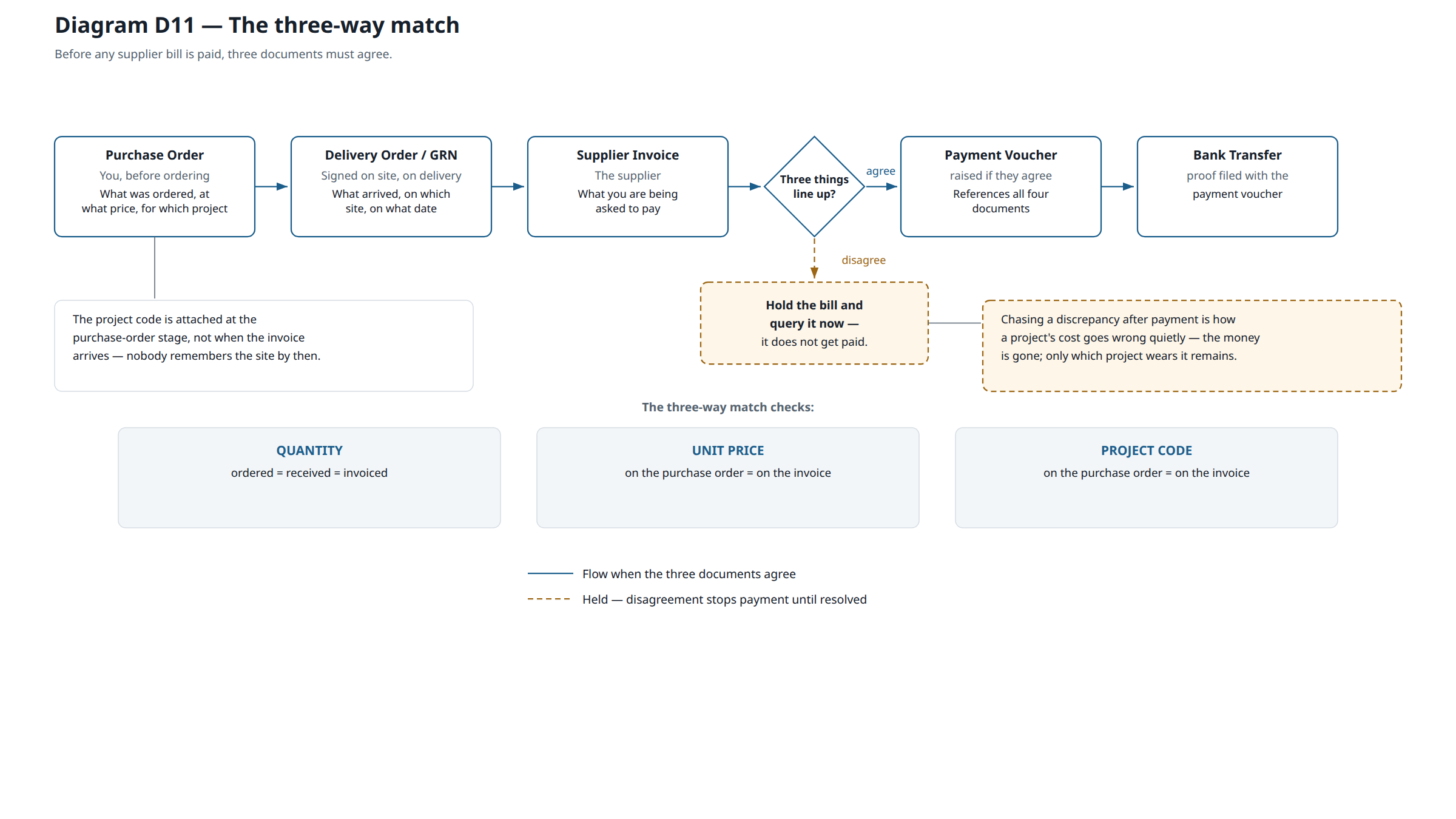
Before any supplier bill is paid, three documents must agree.
| Document | Who produces it | What it fixes |
|---|---|---|
| Purchase order | You, before ordering | What was ordered, at what price, for which project |
| Delivery order or goods received note | Signed on site, on delivery | What arrived, on which site, on what date |
| Supplier invoice | The supplier | What you are being asked to pay |
Three things line up: quantity ordered equals quantity received equals quantity invoiced; unit price on the order equals unit price on the invoice; project code on the order equals project code on the invoice. If they agree, raise the payment voucher and pay. If not, hold the bill and query it now.
Two points matter. The project code is attached at the purchase-order stage, not when the invoice arrives — by invoice time nobody remembers which site the goods went to. And if the three disagree, the bill does not get paid: chasing a discrepancy after payment is how a project's cost goes wrong quietly, because the money has gone and the only question left is which project wears it.
The payment voucher then references all four documents, and the bank transfer proof is filed with it.
Some documents serve two purposes, and photocopying them into both folders is how a system rots: two copies drift, and nobody knows which is current. File the document where it was created, note it where it is needed.
| Document | Filed under | Noted in |
|---|---|---|
| Bank statement showing a project payment | /03-Accounts for that month | The payment voucher in the project folder |
| Supplier invoice covering three projects | /10-Project-Costs of the largest | A one-line note in the other two, with the split basis |
| Insurance policy covering all sites | /01-Statutory | /01-Contract of each project it names |
| Retention release payment | /03-Accounts for the month | /06-Retention of the project it closes |
| Payroll for site workers on one project | /04-Payroll | Coded to the project as a labour cost |
Payroll tempts duplication most. KU 5/2025 s.13(a)(v) names bills and receipts for purchases, expenses and payments including contract workers' wages among the information required when auditing a construction contractor. Those records stay in the payroll branch; the cost reaches the right project through the coding, not a duplicate file.
Ketetapan Umum No. 4/2000, Penyimpanan Rekod Yang Mencukupi (Syarikat & Koperasi), says what a company must actually hold. Its s.3.3.1 requires records and books of account including the cash book, sales ledger, purchase ledger and general ledger — the books depending on the type and size of the business — and requires supporting documents to be kept: invoices, bank statements, pay-in slips, cheque stubs, payment receipts, wage records and copies of receipts issued.
The same paragraph sets a deadline most contractors miss:
Catatan yang sesuai bagi setiap transaksi perlu direkod secepat mungkin (dalam apa jua kes tidak melebihi 60 hari dari tarikh transaksi).
Translation: appropriate entries for each transaction must be recorded as soon as possible (in any case not exceeding 60 days from the date of the transaction). KU 4/2000 s.3.3.1.
The Companies Act 2016 runs the same clock from the company-law side. Section 245(2) requires a company, its directors and its managers to "cause appropriate entries to be made in the accounting and other records within sixty days of the completion of the transactions to which the entries relate." Sixty days is why the monthly close below exists; a quarterly habit already breaches it.
Also from s.3.3.1: where gross takings for a year exceed RM150,000 from the sale of trading goods, or RM100,000 from the provision of services, receipts issued must be serially numbered. Most contractors clear both.
Section 3.3.4 requires records and books of account kept at the registered office or business premises in Malaysia; where records for operations outside Malaysia are kept abroad, they must be brought to the registered office or business premises in Malaysia when the Director General asks for them.
On scans: KU 4/2000 s.4.2 defines Rekod as including the original source document. Scan for the working copy, but do not throw the original away on the strength of the scan.
The consequences are not trivial. KU 4/2000 s.3.4.2 provides that the company or co-operative, or the person responsible, may be prosecuted and on conviction is liable to a fine of not less than RM200 and not more than RM2,000, or imprisonment not exceeding six months, or both — and s.3.4.1 adds that chargeable income may be determined at the Director General's discretion, with assessment raised accordingly. That discretion is usually the more expensive half. The company-law figures are far larger: Companies Act 2016 s.245(9) provides for a fine not exceeding five hundred thousand ringgit or imprisonment not exceeding three years, or both.
| Step | What you do | What it produces |
|---|---|---|
| 1 | File every document that arrived, named to the convention | An empty inbox tray |
| 2 | Code every supplier bill — project or OVERHEAD, period, category | No uncoded bills carried forward |
| 3 | Complete the three-way match on every unpaid bill | Queries raised while people remember |
| 4 | Check each progress claim issued has its certificate and e-Invoice filed | A complete income trail per project |
| 5 | Check each subcontractor payment has its full file pack | A defensible deduction |
| 6 | Update the retention register — receivable and payable, per project | Balances nobody has to reconstruct |
| 7 | Reconcile the bank statement to payment vouchers | Every line traced to a project or overhead |
| 8 | Confirm all entries are within 60 days of the transaction | KU 4/2000 s.3.3.1; Companies Act 2016 s.245(2) |
Honest guidance has to say something uncomfortable here: the instruments do not agree, and they are not measuring from the same event.
| Instrument | Period | The clock starts from |
|---|---|---|
| KU 4/2000 s.3.3.5 | At least six years | The date of the end of the calendar year in which the accounts are closed |
| KU 4/2000 s.3.3.5, appeal override | Until the appeal is concluded | An appeal against an assessment |
| KU 3/2015 s.6, citing ITA ss.82 and 82A | Seven years | The end of the year of assessment in which the return was furnished |
| Companies Act 2016 s.245(3) | Seven years | Completion of the transactions or operations to which the entries relate |
KU 4/2000 s.3.3.5 reads:
Rekod dan buku-buku akaun perlu disimpan sekurang-kurangnya enam tahun dari tarikh akhir tahun kalendar di mana akaun ditutup. Jika terdapat rayuan terhadap taksiran, rekod dan buku-buku akaun yang relevan perlu disimpan sehingga rayuan itu selesai.
Translation: records and books of account must be kept at least six years from the date of the end of the calendar year in which the accounts are closed. Where there is an appeal against an assessment, the relevant records and books of account must be kept until the appeal is concluded.
KU 3/2015, Kegagalan Mengemukakan Maklumat Dalam Tempoh, s.6 gives a different figure from a different event:
Menurut seksyen 82 dan 82A ACP, rekod dan dokumen hendaklah disimpan bagi tempoh tujuh tahun daripada akhir tahun taksiran yang di dalamnya BNCP dikemukakan.
Translation: under sections 82 and 82A of the Income Tax Act, records and documents must be kept for seven years from the end of the year of assessment in which the tax return was furnished.
The Companies Act 2016 runs a third clock, and it is the odd one out because it is per-transaction rather than per-year. Section 245(3): "The company shall retain the records referred to in subsection (1) for seven years after the completion of the transactions or operations to which the entries relate." On a three-year contract, first-year transactions complete long before the last.
One thing cannot be resolved from the sources available. KU 3/2015 s.6 does not refer to KU 4/2000, 5/2000 and 6/2000 as issued in 2000; it refers to each as (Dipinda) — amended. Those amended editions are not held here. Whether the six-year figure in KU 4/2000 s.3.3.5 survived that amendment cannot be confirmed from the editions available.
So what do you do? The instruments run different clocks from different events, so no single date satisfies all of them. The safe reading — and it is a reading, not something any one instrument requires — is to keep everything for the longest period, measured from the latest event: seven years from the later of the end of the year of assessment in which the return was filed and completion of the last transaction on the contract, and longer while an appeal runs, because KU 4/2000 s.3.3.5 keeps the records alive until it concludes.
For a contractor: keep the whole project folder intact for seven years after the final account is settled and the return covering it filed. Do not thin it out project by project, and destroy nothing while an assessment is under appeal.
You now have a tree, a naming convention, a project code on every bill and a check before every payment. Part three covers what all of it was for: project costing and the financial year — how coded costs become a cost per contract, what happens to a project still running at year end, and what your accountant will ask for.
No. Keep one tree and put the role into the project code — M- where you are the main contractor, S- where you are the subcontractor. Two trees make a beginner learn two structures, and they break on a job where both roles apply. Because the code sits in every filename, one tree still shows the role everywhere.
Ask while someone still remembers, then write on the bill how you established it. If it serves several projects, split it on a stated basis and write that basis down. If it serves the company as a whole, code it to overhead rather than forcing it onto a project.
The instruments differ. KU 4/2000 s.3.3.5 says at least six years from the end of the calendar year the accounts are closed, and until any appeal concludes. KU 3/2015 s.6, citing sections 82 and 82A of the Income Tax Act, says seven years from the end of the year of assessment the return was furnished. Companies Act 2016 s.245(3) says seven years after completion of the transactions or operations. The clocks start from different events, so keeping to the longest, measured from the latest event, is the safe reading.
It cannot be settled from the editions available. KU 3/2015 s.6 refers to KU 4/2000 as an amended edition — (Dipinda) — and that edition is not held here, so whether the six-year figure survived is unknown. Seven years from the latest applicable event is the safe position, and meets the Companies Act requirement too.
Be careful. KU 4/2000 s.4.2 defines a record as including the original source document, and s.3.3.4 requires records and books of account kept at the registered office or business premises in Malaysia. Scan for the working copy, keep the original, and keep it in Malaysia.
A filing system survives an audit for one reason: every number in the accounts walks back to a document, and every document says which project it belongs to and when. The folder tree gives each contract its own place, which KU 5/2025 s.11.3.4 requires anyway. The naming convention makes a file findable without opening it. The project code on every bill makes a cost per contract possible. The three-way match stops a wrong number entering at all.
The retention question has no tidy answer, and pretending otherwise would be worse than saying so. Three instruments, three clocks, one running from a text a later ruling says has been amended. Keep everything seven years from the latest applicable event, longer while an appeal is live, and the disagreement stops mattering.
Ashraf Ibn Zelt writes on Malaysian tax compliance and bookkeeping for Zelt Digital, an accounting and tax services platform serving SMEs and professional firms with LHDN compliance, e-Invoice implementation, payroll and CFO advisory across Malaysia. Visit zelt.digital to learn more.
Related reading: How Long to Keep Accounting Records in Malaysia